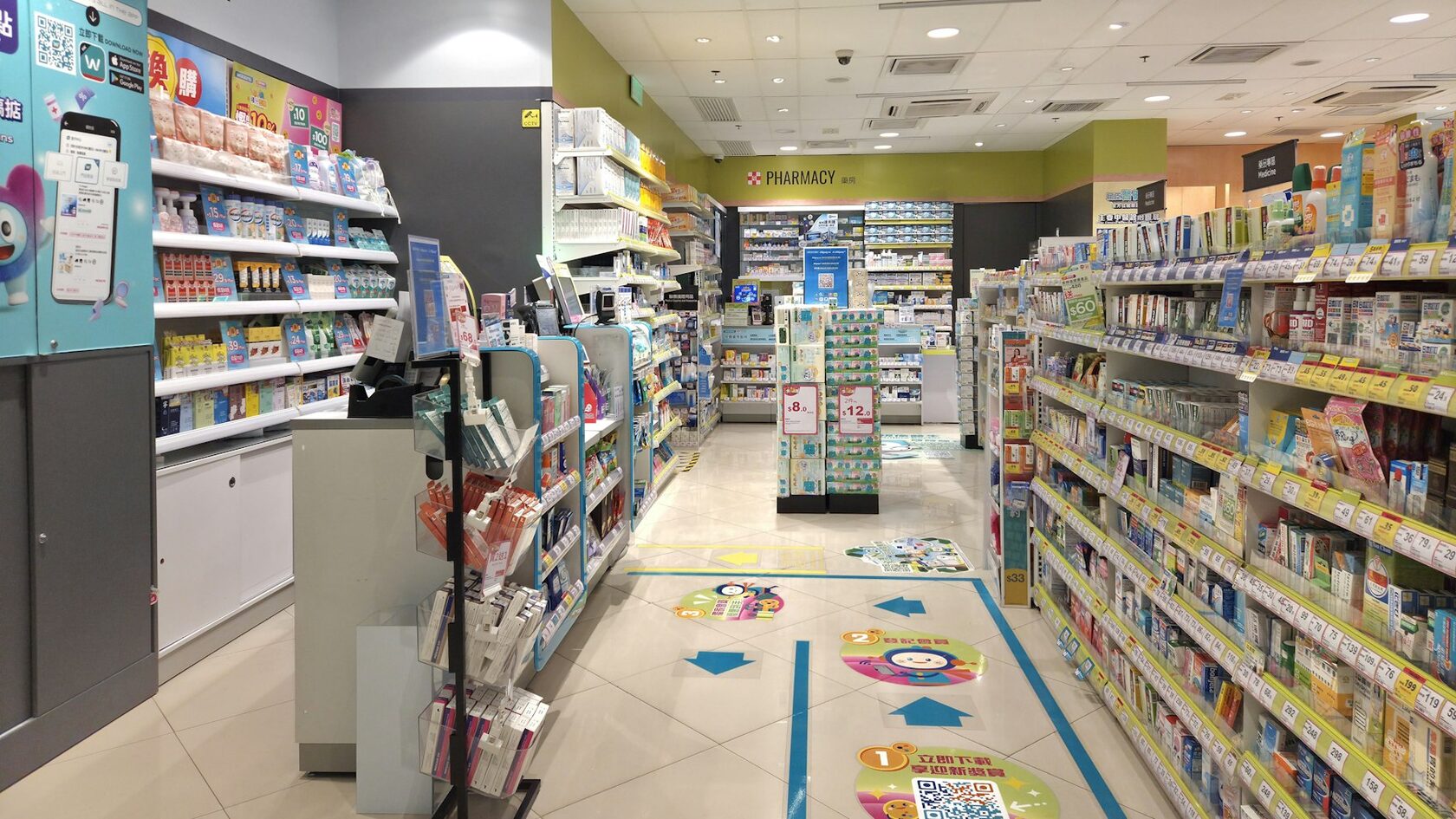
dm is Germany's largest drugstore chain by sales: €19.2 billion including VAT in the year to September 2025, €13.3 billion of it in Germany, where 2,154 stores serve 2.2 million customers a day. In our experience its leases are signed by the national operating company, owned by a charitable foundation and the Lehmann family. The covenant is rarely the issue; the building is — dm adds few stores and is renewing hundreds, so a unit that misses its format is the one at risk.
Key takeaways
• dm turned over €19.2 billion including VAT in the year to September 2025 (+8.2%), €13.3 billion in Germany, and reports a 27.5% share of German drugstore-product sales.
• In our experience, leases are signed by dm-drogerie markt GmbH + Co. KG, the Karlsruhe headquarters company; dm is unlisted, and we found no public credit rating.
• An average of 2.2 million customers a day in Germany (2024/25), roughly 1,000 per store (our calculation), makes a drugstore the natural partner of a supermarket and a discounter.
• The network is mature: 2,069 German stores in 2020/21, 2,154 in 2024/25. dm's published criteria — in a retail park, 500 m² at ground level and about 50 parking spaces — are the yardstick.
A privately owned market leader funds growth from cash flow
Exhibit 1. One national company runs dm's 2,154 German stores
dm belongs in equal halves to a charitable foundation and to Kevin David Lehmann. Götz W. Werner opened the first store in Karlsruhe in 1973. From 1974 Günther Lehmann, of the family behind the grocer Pfannkuch, financed the expansion in return for 50% of the shares, which now belong to his son. Werner, who died in 2022, transferred his own 50% to the foundation; his son Christoph has led the management since 2019.
dm's annual release reports turnover, not profit, but shows how dm pays for growth: about €200 million invested in 2024/25 and more than €250 million planned for 2025/26, "from operating cash flow". Its nearest rival, Rossmann, has more German stores (2,342) but lower German sales (€10.5 billion, 2025).
The tenant is the headquarters company, not a store company
In our experience, the tenant in a German dm lease is dm-drogerie markt GmbH + Co. KG itself. It is a limited partnership whose fully liable partner is a limited company, dm-drogerie markt Verwaltungs GmbH; the 2015 berlinovo renewal in Bendorf names the same entity. The landlord's claim runs against the Karlsruhe headquarters company, not a store company or a merchant.
That is the main difference from EDEKA and REWE, where an independent merchant may sign (Part 2): dm runs its German stores with its own staff, 63,648 employees at 30 September 2025.
dm wants ground-floor space, parking and 20,000 people within reach
Exhibit 2. In a retail park, dm wants at least 500 m² at ground level and about 50 parking spaces
Source: dm-drogerie markt, expansion page (accessed 10 October 2026).
dm's criteria say nothing about neighbours, and in a retail park they need not. Our experience is that the combination drawing the most visitors to a food-anchored park is a drugstore next to a supermarket and a discounter (Part 2). Online orders increasingly end in the store too: dm had 1,847 pick-up stations in Germany in October 2025.
The network barely grows: 2,069 German stores in 2020/21, 2,154 in 2024/25, with the average sales area up from 631 m² to 640 m². Turnover did the growing, from €9.04 billion to €13.27 billion in Germany over the same period. For 2025/26 dm plans "a moderate increase" in locations and the renewal of "hundreds" of stores in a new design.
Published renewals show dm committing for a decade or more
dm publishes no standard lease; its expansion page promises a "partnership-based tenancy", which is intent, not a clause. Landlords' announcements are more concrete. In 2014 berlinovo reported a renewal of at least 12 years for about 900 m² in the Südpark retail park in Neuburg an der Donau, whose tenants include EDEKA. In 2015 it reported one of at least ten years for about 660 m² in a Kaufland- and Lidl-anchored centre in Bendorf.
In our experience, dm negotiates on its own template, as the food retailers do. Its terms: indexation only above a threshold and often only in part, roof and structure with the landlord (Part 10), subletting within the group and extension options for the tenant. Each store is negotiated separately (Part 7).
The risks sit in the building, the anchor and the channel
Format. A retail-park unit under 500 m², off the ground floor or without its own parking competes for dm's investment with better sites.
Anchor. A drugstore in a retail park trades on shared traffic; if the supermarket or discounter leaves, it loses part of its reason to stay.
Channel. dm's online sales grew at a double-digit rate in 2024/25, faster than its stores; pick-up stations keep part of that demand in the building.
Implications for investors
1. Underwrite the building against dm's yardsticks. The covenant is rarely in doubt; a retail-park unit below 500 m² at ground level, or without about 50 parking spaces, is where the renewal risk sits.
2. Read the drugstore lease with the anchor's. dm shares its traffic with the supermarket and the discounter, so the remaining terms of all three leases belong in one analysis.
3. Treat the options as dm's choice. Renewals of at least ten and 12 years show dm's willingness to commit — where the site still fits its format.
Before you buy a dm store:
• Confirm that the lease names dm-drogerie markt GmbH + Co. KG, Karlsruhe, and read the subletting clause.
• Measure the unit against dm's criteria: in a retail park 500 m² at ground level, about 120 m² ancillary space and about 50 parking spaces; in town 400 m² and an 8 m frontage.
• Ask whether the store has been, or will be, refurbished in dm's new design.
• Compare the drugstore's fixed term and options with the supermarket's and the discounter's.
• Check the indexation threshold, the share passed on and who pays for roof and structure (Part 10).
• Obtain the complete lease file, every addendum included (Part 7).
Sources: dm-drogerie markt, press release of 21 October 2025 and dm.de pages "dm in Zahlen", "Expansion", "Kurzporträt" and imprint (accessed 10 October 2026); LEBENSMITTEL PRAXIS, 22 October 2025; WirtschaftsWoche, 28 August 2017 and 8 February 2022; apotheke adhoc, 28 August 2017; Forbes, Kevin David Lehmann profile; berlinovo, 12 May 2014 and 14 January 2015; Bundeskartellamt, 28 September 2026; Rossmann, business report 2025; Gordon Real Estate Group experience.
Photo: Cheung Yin / Unsplash
This profile is general information and not investment advice. Company figures are as published by the company or reported in the trade press on the dates stated.