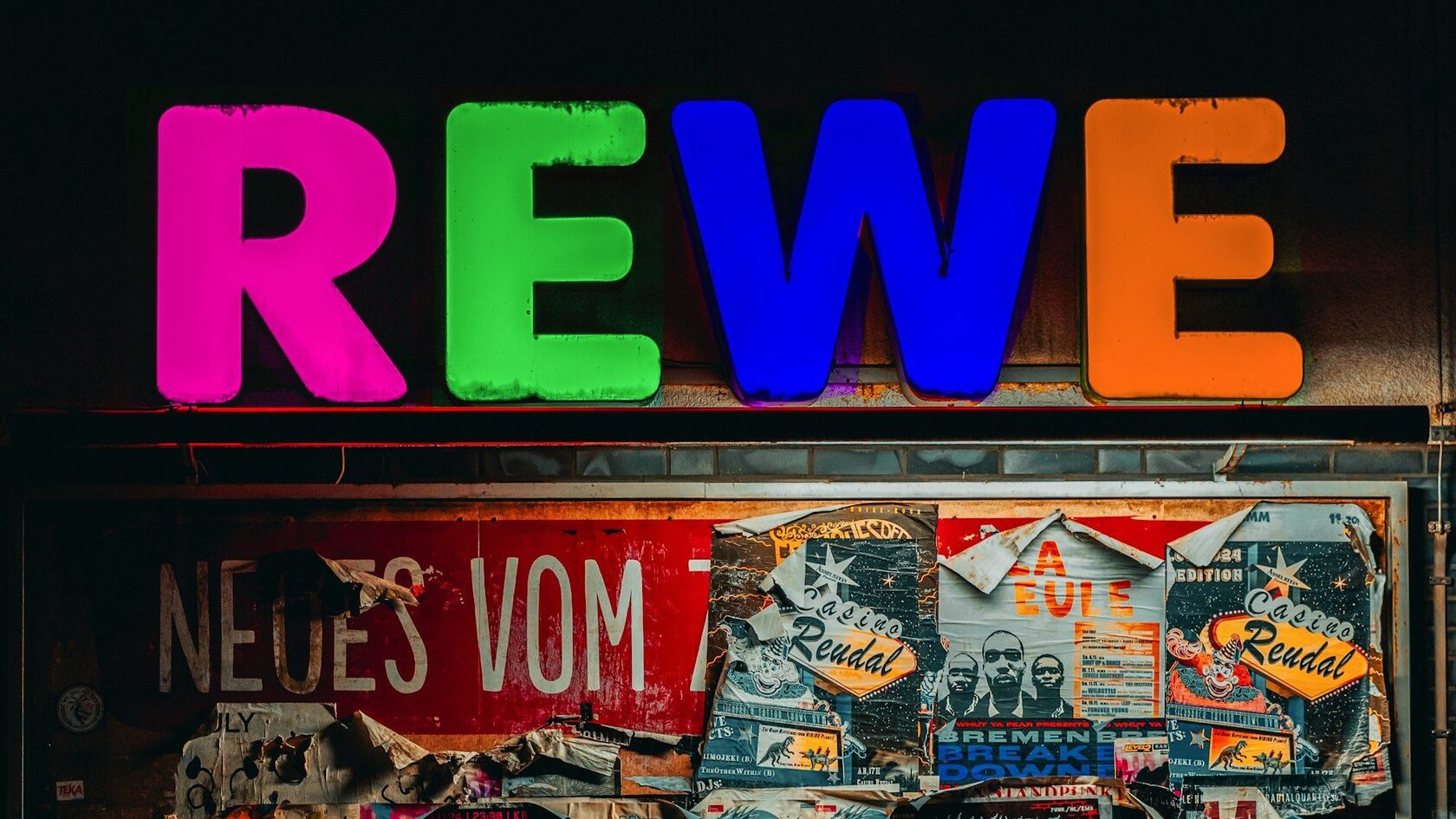
Lease liabilities — the present value of contracted rent — are the REWE Group's largest liability: €14.0 billion at the end of 2025, almost all for property, against about €4.3 billion of interest-bearing debt. Yet many REWE stores are run by one of 1,620 independent merchants (2025), often under a sublease from this BBB-rated group. Who signed the lease decides what an investor owns.
Key takeaways
• The REWE Group turned over €100.4 billion in 2025 (Germany: €69.1 billion) and, with Penny, holds about 22% of German food retail (Bundeskartellamt, 2025 data). S&P rates it BBB, stable (August 2026).
• In our experience REWE Markt GmbH signs the lease; the group, which sublets many stores to merchants, booked €1.2 billion of sublease income in 2025.
• REWE seeks 500 to more than 6,000 m² of sales area, usually in towns of 5,000 inhabitants or more, and also buys sites (August 2026).
• Its accounts confirm partial indexation: rent may rise by a percentage of the index change; €13.0 billion of €14.0 billion lease liabilities are index- or rate-linked (end-2025).
REWE is a merchants' cooperative with a corporate credit rating
REWE's parent, REWE-Zentralfinanz eG in Cologne, is a registered cooperative with 16 member organisations (end-2025) in which independent merchants have a decisive say; branches trade alongside merchants' stores. The group began in 1927, when 17 purchasing cooperatives joined forces.
Scale is large, margins thin. Total external revenue of €100.4 billion in 2025 includes travel, DIY and convenience wholesale; Germany contributed €69.1 billion, the REWE supermarket division €32.4 billion, up 3.0%. EBITA of just over €1.5 billion was 1.7% of sales in 2025. S&P has rated REWE since 2010; it affirmed BBB, stable, in August 2026.
Exhibit 1. A €100 billion cooperative with an investment-grade rating
REWE Markt GmbH usually signs; the merchant sublets from REWE
REWE runs German expansion from REWE Markt GmbH — a national team and six regional offices — and, in its own territory, from REWE Dortmund, a regional cooperative group (brochure, August 2026). In our experience one of these companies, not the merchant, signs the lease for a new store.
Merchants run a growing share of stores. The group ran 1,420 of REWE's roughly 3,800 German stores as branches at the end of 2025 (REWE and akzenta). Merchants — 1,620 of them, with sales up 7.2% to €20.4 billion in 2025 — run the others. In REWE's partnership model, merchant and group form a general partnership (OHG). REWE Markt GmbH sells branches to merchants — for €41.0 million in 2025 — yet the group stays their landlord: its subleases go primarily to REWE retailers, often at turnover-linked rents.
Two caveats apply. First, REWE Markt GmbH published no accounts of its own for 2025, using the exemption for consolidated subsidiaries (§ 264(3) HGB). The parental undertaking this exemption requires covers obligations entered into up to the balance-sheet date, for the following financial year only: it is no substitute for a lease guarantee. Second, merchants may bring their own sites; in our experience such leases can be in the merchant's name — the covenant of a single merchant (Part 2).
REWE wants 500–6,000 m² in towns of 5,000 or more
REWE's August 2026 brochure asks for 500 to more than 6,000 m² of sales area in towns usually of 5,000 inhabitants or more. It wants city, district and retail-park locations, visible from main roads or served by public transport, normally at ground level. Above 800 m² of sales area a store is large-scale under planning law (Part 3).
REWE also buys: the brochure offers ground leases and purchases alongside renting, and the group named expansion of its real-estate portfolio among its 2025 investment priorities. REWE can thus be a rival bidder for sites, not only a tenant.
REWE's own accounts confirm partial indexation and extension options
REWE's 2025 accounts record part of its lease practice. Real-estate leases often contain extension options, which the group seeks wherever possible. Index clauses are reviewed regularly, with rent rising by a percentage of the index change.
A published renewal shows REWE trading term for investment. In December 2025 the Dr. Peters Group announced that REWE in Beckum had extended a lease running to the end of 2028 by at least 12 years plus four four-year options. REWE modernises its 2,445 m², the landlord contributes €700,000, and the indexed rent rises by almost 15%.
Beyond that, our experience is of 15-year initial terms with extension options and indexation above a threshold, often passing on only part of the change. In the same leases, roof and structure stay with the landlord (Part 10), and the tenant may sublet to merchants and within the group.
Margins, debt and weaker stores are the figures to watch
REWE's covenant rests on scale rather than margin: EBITA was 1.7% of sales in 2025, while the group invested €2.5 billion and plans about €3 billion for 2026. Net debt of €18.1 billion (end-2025) was 3.0 times EBITDA, below an internal ceiling of 3.3. REWE expects it to rise considerably by the end of 2026, mainly through lease liabilities, with the ratio still below that ceiling. Impairments on leased stores with weak earnings doubled to €212.5 million in 2025 — in our view, a sign that REWE weighs each store's earnings before renewing.
Implications for investors
1. Establish who signed before you price the rent. A lease with REWE Markt GmbH or REWE Dortmund makes a company of a BBB-rated group your tenant. One in a merchant's name rests on that merchant alone: ask for a group guarantee.
2. Model indexation as a percentage, not a promise. REWE's accounts confirm that index clauses can pass on only part of inflation; underwrite the threshold and share in your lease.
3. Treat renewal as a negotiation over modernisation. As in Beckum, REWE trades a long extension for investment; budget for a landlord contribution and check that site and permit allow a larger format.
Before you buy a REWE store:
• Who signed — REWE Markt GmbH, REWE Dortmund or a merchant's partnership — and is there a group guarantee?
• Is the store sublet, and may REWE assign or sublet without consent?
• What threshold and share does the index clause set, and must increases be claimed in writing?
• How long is the fixed term, how many options remain, and when was the store modernised?
• Does the sales area fit REWE's formats, and may the store be extended (Part 3)?
• Who maintains fit-out, refrigeration, roof, structure and car park (Part 10)?
Sources: REWE-Zentralfinanz eG, Group Management Report and Consolidated Financial Statements 2025; REWE Group press releases (22 April, 13 June, 17 August 2026), key figures 2025, website and expansion brochure (August 2026); REWE careers site; Bundestag lobby register (R001003); Bundeskartellamt, 28 September 2026; LEBENSMITTEL PRAXIS, 22 April 2026; Dr. Peters Group, 2 December 2025; § 264(3) HGB; Gordon Real Estate Group experience.
Photo: Jahanzeb Ahsan / Unsplash
This profile is general information and not investment advice. Company figures are as published by the company or reported in the trade press on the dates stated.