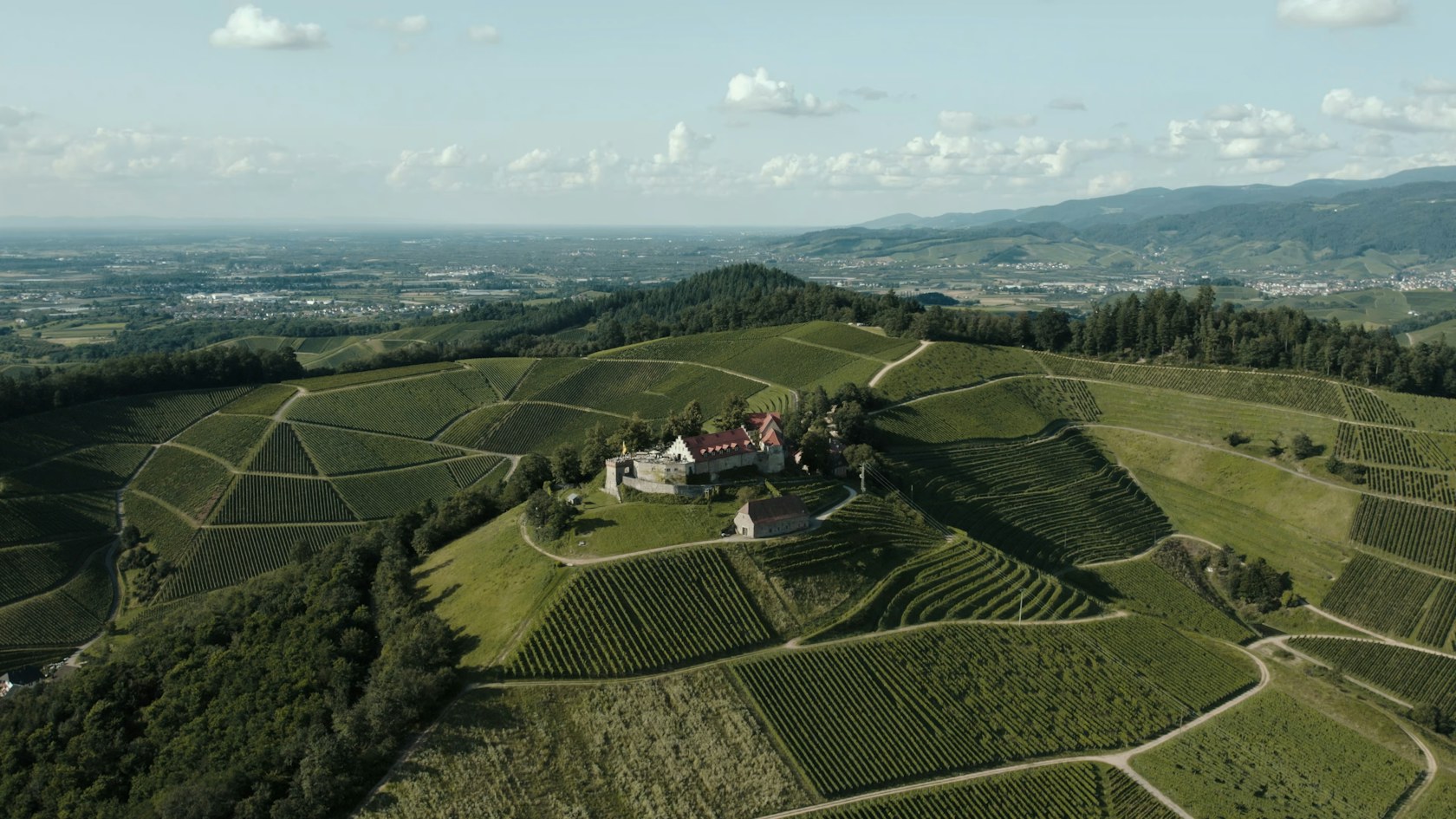
Offenburg supplies a market four times its own size: with 63,437 residents (Destatis, end of 2025), it is a regional centre (Oberzentrum) under Baden-Württemberg's state development plan and puts its market at about 275,000 people. That is both a strength and a dependence: for a grocery store, the catchment beyond the town boundary is less protected than it is for non-food retail. The strongest position belongs to a store that dominates its own neighbourhood and does not live off shoppers from elsewhere.
The town supplies a market four times its own size
Offenburg calls itself the most important business location between Karlsruhe and Freiburg. According to the town, it has more than 55,000 jobs and about 450 shops with 210,000 m² of sales area, and some of its shoppers come from neighbouring Alsace. The scale matches the status: under the state development plan (Landesentwicklungsplan, LEP), a regional centre is to supply an area of several hundred thousand people — as a rule, the whole region (Plansatz 2.5.8).
The population is growing: by 444 people, or 0.70%, in 2025 — faster than in Freiburg (0.35%), Heilbronn (0.40%) and Ulm (0.31%). The Ortenau district, for which Offenburg describes itself as the central shopping town, has 445,855 residents (Destatis).
EDEKA, Burda and the Rhine Valley line shape the economy
Offenburg is home to the headquarters of EDEKA Südwest, one of the EDEKA group's six regional companies. By its own account, the company spans about 1,100 stores, seven logistics centres and five production plants in five federal states; including independent retailers, it has more than 47,000 employees. The media group Hubert Burda Media is also registered in the town; its second base is Munich, and the group has about 8,500 employees. Offenburg University of Applied Sciences has 3,700 students.
The town lists its transport links as the A 5 motorway towards Frankfurt and Basel, with the Offenburg and Appenweier junctions, and an ICE station where the Rhine Valley line meets the Black Forest Railway. Since 9 December 2018 the TGV has stopped here with a direct service to Paris, and Strasbourg airport is 45 minutes away by car.
Exhibit 1. A town of 63,437 people supplies a market of about 275,000
Sources: Destatis; LEP Baden-Württemberg 2002; Stadt Offenburg; EDEKA Südwest.
The basic-supply exception opens the door to nearby competitors
A large share of the turnover of Offenburg's shops comes from outside the town: its market is four times its population. For a grocery store, this outer catchment is less protected than it is for non-food retail. The state development plan admits large stores, as a rule, only in centres, but makes an exception for basic supply in small municipalities (Plansatz 3.3.7). Its explanatory statement names full-range supermarkets outright as the stores increasingly taking over basic supply close to home. A new store in a neighbouring municipality can therefore take some of the shoppers who come into town today (see Part 5 of the series German Prime Retail).
Implications for investors
1. Find out where the store's shoppers come from. Turnover from residents of surrounding municipalities and Alsace is less protected than demand from the store's own neighbourhood.
2. Favour a store that dominates its own neighbourhood. The state development plan permits basic supply in small municipalities too (Plansatz 3.3.7), so a new supermarket nearby can capture some of the incoming shoppers.
3. Check who signed the lease, and for how long. The tenant of an EDEKA store may be a group company or an independent retailer (see Part 7 of the series German Prime Retail).
What to check:
• what share of the store's shoppers live in Offenburg itself, and what share come from surrounding municipalities and Alsace;
• neighbouring municipalities' plans for new grocery stores admissible under the basic-supply exception (Plansatz 3.3.7);
• the site's zoning and room to expand;
• who signed the lease — a group company or an independent retailer — and for what term (see Part 7);
• purchasing-power and retail-centrality indices for the catchment: request them from a broker or the chamber of commerce (IHK Südlicher Oberrhein);
• the timetable of Deutsche Bahn's works on the Rhine Valley line, if the site lies near the route.
See also: Commercial property in Freiburg; How do you choose a town to buy a supermarket in Germany?; Nahversorgung (local supply); Real estate transfer tax in Germany 2026: rates by state.
Sources: Destatis, Gemeindeverzeichnis-Informationssystem (GV-ISys), data as of 31 December 2024 and 2025; Landesentwicklungsplan Baden-Württemberg 2002, Plansätze 2.5.8 and 3.3.7 with explanatory statement; Stadt Offenburg, "Einkaufsstadt" and "Verkehrsinfrastruktur" sections (October 2026); EDEKA Südwest, official website (October 2026); Hubert Burda Media, "Unternehmen" and "Impressum" sections (October 2026); Hochschule Offenburg (October 2026); § 1 GrEStFestG BW; German Prime Retail series, Parts 5 and 7.
Photo: Julien Goettelmann / Unsplash
This page is general information and not investment, legal or tax advice.