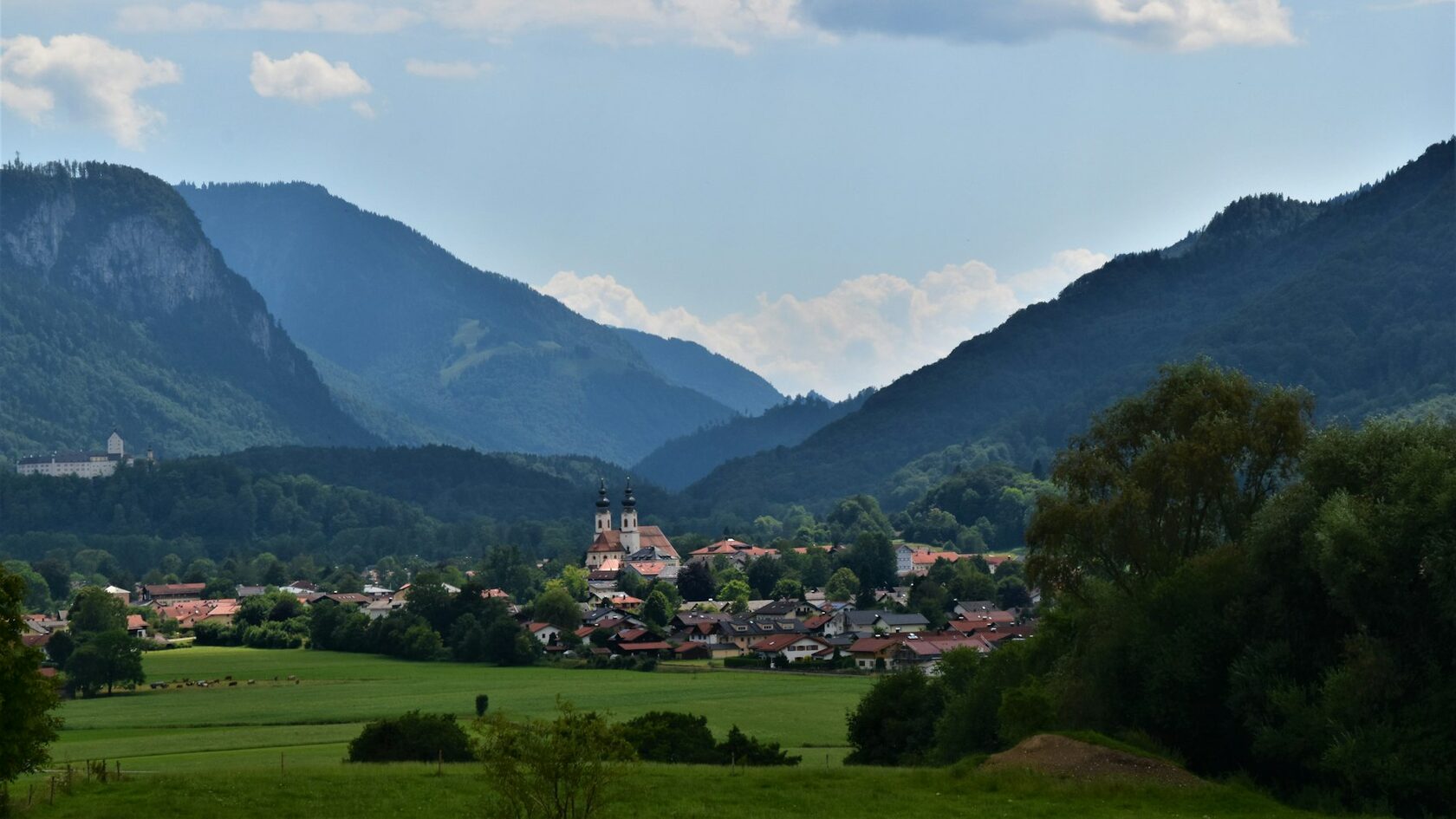
The German district with the most spending power is not Berlin, Frankfurt or Hamburg. It is Starnberg, a county of lakes and villages south-west of Munich, where purchasing power — disposable income per head, as NIQ measures it — reaches €42,751, 37% above the national average. The city of Munich ranks only third, behind its own surrounding county; Berlin, the capital, sits below the national average. For investors in food-retail property this is more than a curiosity. In a country without a dominant metropolis, some of the most secure supermarket income is earned not in the big cities but in prosperous market towns — provided the investor understands the planning rules behind it, and their limits.
Key takeaways
• Germany's purchasing power is decentralised: affluent suburban and rural counties often out-earn the major cities — the Hochtaunus county outside Frankfurt by almost a fifth per head.
• The seven A-cities offer liquidity at a premium price: the prime yield of 5.00% in the third quarter of 2026 — in our experience the floor for metropolitan stores — sits only about 1.5 percentage points above ten-year German government bonds, a margin many long-term investors find too thin.
• German planning law confines large-scale stores with more than minor effects on their surroundings to core areas or special zones, and regional plans steer them to designated central places. A full-range supermarket that already holds such a site has an advantage that is hard to replicate — though not a legal monopoly.
• Smaller locations trade liquidity for income — a trade-off that works only with a dominant store, a long lease and a stable or growing catchment.
Purchasing power peaks in prosperous counties, not in the capital
Germany is a federal state by design and a decentralised economy by history. Its industrial champions are headquartered in places such as Wolfsburg, Walldorf, Herzogenaurach and Ingolstadt; its Mittelstand — the family-owned mid-sized firms that dominate global niches — sits in hundreds of small towns. Income follows employment, and employment is spread across the map.
The purchasing-power data confirm the pattern. According to NIQ (formerly GfK), the top five of Germany's 400 districts by purchasing power are Starnberg, the county of Munich, the city of Munich, the Hochtaunus county north of Frankfurt and Ebersberg — four of them in the Munich region, and only one of them a city. The national average for 2026 is €31,193 per head.
Exhibit 1. Of the states shown, Bavaria pairs the highest purchasing power with the lowest transfer tax
Sources: NIQ, Kaufkraft Deutschland 2026 (January 2026); state transfer-tax laws, as of October 2026. Selected states.
The transfer-tax column is a cost of entry, not a footnote: on a €10 million store, transfer tax costs €350,000 in Bavaria and €650,000 in North Rhine-Westphalia — €300,000 that the location's yield must first earn back.
A-cities offer liquidity, but buyer competition compresses yields
Real-estate analysts at bulwiengesa classify German cities by economic importance. The seven A-cities — Berlin, Düsseldorf, Frankfurt, Hamburg, Cologne, Munich and Stuttgart — are the markets of national and international significance. B-cities are large cities of national and regional importance; C-cities are important regional centres with some national reach; D-cities are smaller, regionally focused towns that anchor their immediate surroundings.
For a supermarket investor, A-cities offer two advantages: dense populations and deep, liquid investment markets in which a good asset can be sold quickly. The price of those advantages is high: competition among buyers is intense, land is expensive, and sellers build a "metropolitan premium" into every discounter and supermarket they bring to market. Yields compress accordingly: BNP Paribas Real Estate puts the prime yield for the best single supermarkets and discounters at 5.00% in the third quarter of 2026 — in our experience the floor at which metropolitan stores trade, and only about 1.5 percentage points above ten-year German government bonds (3.55% on 7 October 2026).
We therefore see many institutional and private investors widening their search to B-, C- and D-cities, and beyond them to district towns and affluent rural regions.
The market town's moat is planning law, not purchasing power
Purchasing power shapes what a store sells more than how much. Households spend a falling share of rising incomes on food — Engel's law — so an affluent county does not fill a supermarket proportionally faster than an average one; affluence shows mainly in the format and the basket, favouring full-range stores and premium ranges over discount. Volume follows people: NIQ's purchasing-power density, in euros per square kilometre, is highest in Munich and Berlin. What turns a catchment into durable income is the absence of a rival — and that is where planning law comes in.
In Germany, a large-scale store — one with more than 800 m² of sales area, as the Federal Administrative Court has held (BVerwG, 24 November 2005, 4 C 10.04) — that can have more than minor effects on regional planning or on a town's development may be built only in a core area or in a special zone designated for it (Kerngebiet, Sondergebiet; § 11(3) sentence 1 BauNVO). Such effects — on traffic, local supply and town centres, in the same or neighbouring municipalities — are presumed as a rule once floor space (Geschossfläche) exceeds 1,200 m²; the presumption can be rebutted either way, having regard to the size of the municipality, local supply and the store's range (§ 11(3) sentences 2–4 BauNVO).
State and regional development plans, which bind municipalities when they zone (§ 1(4) BauGB), add a second filter: they channel large-scale retail to "central places" — towns designated to supply their surroundings — and shield town centres from out-of-town competition. Some states relax this for everyday supply: Bavaria allows local-supply stores of up to 1,200 m² of sales area in every municipality (LEP Bayern, objective 5.3.1).
For an investor, the consequence is concrete: a district town of 10,000 inhabitants may serve a catchment of 30,000 or more. The five to ten villages around it are too small — under the regional plan and by the retailers' own arithmetic — to support a full-range supermarket of their own, and most are unlikely ever to get one. Those villages typically have a small discounter at most — a store with a few thousand product lines — while the large full-range REWE and EDEKA stores we sell offer 15,000 to 40,000. For the weekly shop, residents travel to the town.
An investor who owns the dominant full-range store in such a town — central location, largest sales area, best parking — owns a position that new competitors find hard to replicate. That advantage must be verified site by site, and it is not a legal entitlement: German planning law is neutral towards competition, and an incumbent has no claim to be shielded from a new rival (BVerwG, 10 July 2020, 4 BN 50.19). What the law protects is the town centre and local supply; the store that already anchors them benefits as a side effect — durably, but not unconditionally.
An example: the "outskirts" that were not
In the summer of 2024, a long-established developer group mandated Gordon Real Estate Group to sell a newly built full-range supermarket on the edge of a village of 7,500 inhabitants near Hanover. On the map the site looked peripheral. In reality the village is the local centre for nine surrounding villages, none of which is large enough to support a full-range store of its own. The tenant, one of Germany's four largest food retailers, had already traded on the same plot for twenty years — and signed a new 20-year lease, rather than the customary 15, with a preferential right of renewal. Few signals of location quality are stronger than a retailer committing to the same site for four decades.
When the moat locks the owner in
The same rules can turn against the owner. Grandfathering (Bestandsschutz) protects the store as approved, not the larger store the tenant will want at the next renewal — and retailers want more space: the "silent reserve" of some 450 m² per supermarket and 250 m² per discounter that BNP Paribas Real Estate identifies (Part 3) pays only if the site can grow. An extension beyond what the site's zoning allows — a sales-area cap in the special-zone plan, or the large-scale thresholds in an ordinary zone — needs a new or amended development plan that respects the regional plan. If the plot cannot grow, the municipality may zone a new site for the tenant across town, and the owner discovers that the moat protects the town's supply, not the building. Whether a site can take the next format belongs on every small-town checklist.
Higher small-town yields work only under three conditions
Supermarkets in smaller towns are typically priced at higher net initial yields than comparable stores in the metropolises — above the prime benchmark rather than at it — because land is cheaper and fewer buyers compete. That additional income is compensation for something real: a thinner pool of buyers on exit, few alternative tenants should the incumbent leave, and, in some regions, demographic decline.
The trade-off therefore works only under three conditions. The store must be the dominant food-retail offer in its catchment. The lease must be long and signed with a first-class tenant. And the catchment's population must be stable or growing. Large parts of Bavaria, Baden-Württemberg, Hesse and the Rhineland meet the third condition comfortably; some rural districts in eastern and northern Germany do not.
Implications for investors
1. Widen the search beyond the A-cities. The 5.00% prime yield is, in our experience, the floor for metropolitan stores; in smaller towns, comparable stores are typically priced above that benchmark.
2. Buy the planning position, not the purchasing power. Verify site by site that the store is the dominant food-retail offer in a designated central place, on a long lease with a first-class tenant and in a stable or growing catchment.
3. Confirm that the site can take the next format. Grandfathering protects the store as approved, not the larger one the tenant will want at renewal; if the plot cannot grow, the municipality may zone a new site for the tenant across town.
Testing a small-town supermarket:
• the town's status as a central place in the state or regional development plan;
• population trend and forecast for the town and its catchment;
• competition within a ten-minute drive, and any planned or permitted new stores;
• the store's sales area, parking and position relative to the town centre;
• the site's zoning — core area or special zone, any sales-area cap — and whether it permits the extension the tenant will want at renewal;
• the remaining lease term, options and the tenant's own investment in the store.
Sources: NIQ, Kaufkraft Deutschland 2026 (press release, 14 January 2026); bulwiengesa city classification; BNP Paribas Real Estate, Retail-Investmentmarkt Deutschland Q3 2026 and Grocery-Investmentmarkt Deutschland 2025; § 11(3) BauNVO; § 1(4) BauGB; Bavarian State Development Programme (LEP Bayern), objective 5.3.1; BVerwG, judgment of 24 November 2005, 4 C 10.04; BVerwG, decision of 10 July 2020, 4 BN 50.19; Deutsche Bundesbank, yield curve (7 October 2026); state transfer-tax laws (October 2026); Gordon Real Estate Group transaction experience.
Photo: Waldemar Brandt / Unsplash
This article is general information and not investment advice. Yields and market conditions vary by location and change over time.