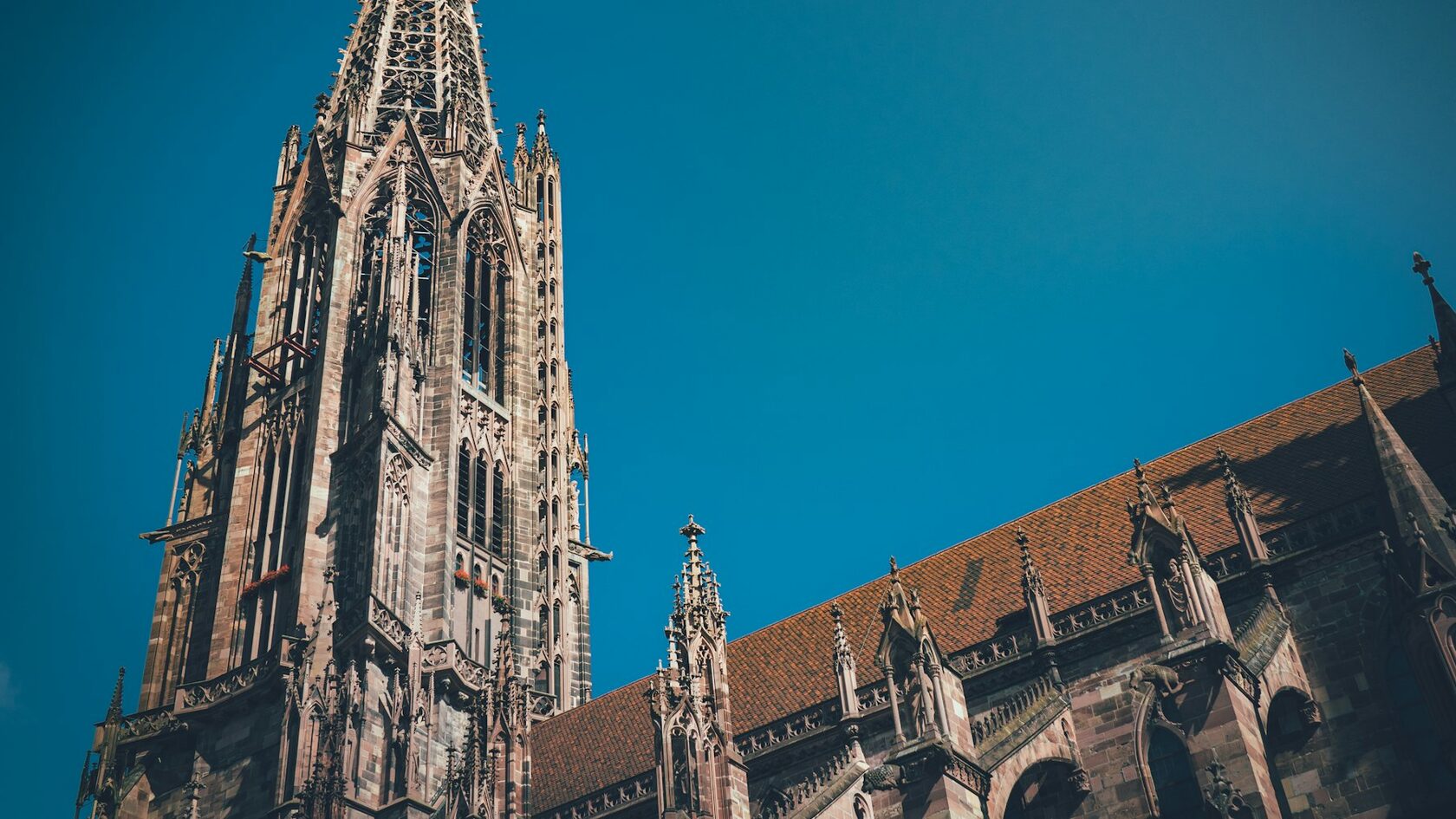
Freiburg's demand rests on a growing population and on large institutions: the university hospital alone employs 15,000 people. The city had 238,299 residents at the end of 2025, 839 more than a year earlier (Destatis), and the state development plan charges this regional centre (Oberzentrum) with supplying several hundred thousand people. The catch is the cost of entry: real estate transfer tax (Grunderwerbsteuer) takes 5.0% of the price, and the plan does not allow new large stores just anywhere.
A university, a hospital and a growing population anchor demand
Freiburg's economy is built on institutions that do not relocate. The university hospital reports 15,000 employees. The university, founded in 1457, is one of the oldest in Germany, with 11 faculties and about 240 degree programmes. The population grew by 0.35% in 2025, while Ingolstadt and Erfurt lost residents over the same year (Destatis).
Freiburg is also the core of a wider market: the fourth-largest city in Baden-Württemberg and the largest in the Southern Upper Rhine region (Südlicher Oberrhein). Together with the districts of Breisgau-Hochschwarzwald, Emmendingen and Ortenau, the region has about 1.13 million inhabitants (our calculation from Destatis data). Baden-Württemberg itself ranks third among the German states for purchasing power: €32,813 per head in 2026, an index of 105.2 (NIQ).
Rail will strengthen the city's role as a transport hub. Deutsche Bahn is rebuilding the Rhine Valley line between Karlsruhe and Basel, and the project includes the Gundelfingen–Freiburg and Freiburg–Ehrenkirchen sections. Once it is complete, trains will cover the whole line in about 70 minutes, 20 minutes faster than today.
Regional-centre status widens the supply area but narrows the choice of sites
Baden-Württemberg's state development plan (Landesentwicklungsplan, LEP) dates from 2002, and the state is now preparing its replacement. It charges regional centres with supplying an area of several hundred thousand people — as a rule, the whole region (Plansatz 2.5.8).
The same plan admits large retail projects (Einzelhandelsgroßprojekte), as a rule, only in regional centres, middle-order centres (Mittelzentren) and lower-order centres (Unterzentren; Plansatz 3.3.7), and primarily in integrated locations (3.3.7.2). A store's sales area must be sized so that its catchment does not substantially exceed the centre's supply area (3.3.7.1). For a regional centre, whose supply area under the plan is the whole region, that limit is wider than for a district town. Yet here too the plan narrows the choice of sites (see Part 3 of the series German Prime Retail).
Exhibit 1. Freiburg is gaining residents and supplies a region of about 1.13 million people
Sources: Destatis; LEP Baden-Württemberg 2002; hospital and university data; regional population: our calculation.
Implications for investors
1. Do not expect the yield premium that small towns offer. In our experience, competition for a good store is stiffer in a city of this size than in a district town (see Part 5). In return, the buyer gets demand anchored by large institutions and a growing population.
2. Value the site by its place in the planning system. The state development plan steers new large stores to the centres, so an integrated site with room to expand is worth more than one on the edge of town.
3. Build the transfer tax into the yield calculation. Real estate transfer tax is 5.0%, or €500,000 on a €10 million price — money the property must first earn back.
What to check:
• the site's location — integrated or on the edge of town — and whether its zoning permits an extension under Plansätze 3.3.7–3.3.7.2 of the LEP;
• competitors within a ten-minute drive and projects already approved;
• purchasing-power and retail-centrality indices for the catchment (NIQ, MB-Research): they are sold under licence, so request them from a broker or the chamber of commerce (IHK Südlicher Oberrhein);
• the timetable of Deutsche Bahn's works on the Rhine Valley line, if the site lies near the route;
• the lease: remaining term, options and the tenant's own investment in the store;
• the 5.0% real estate transfer tax and other acquisition costs in the price and yield calculation.
See also: Commercial property in Offenburg; How do you choose a town to buy a supermarket in Germany?; Landesentwicklungsplan (state development plan); Real estate transfer tax in Germany 2026: rates by state.
Sources: Destatis, Gemeindeverzeichnis-Informationssystem (GV-ISys), data as of 31 December 2024 and 2025; Landesentwicklungsplan Baden-Württemberg 2002, Plansätze 2.5.8, 3.3.7–3.3.7.2; Ministerium für Landesentwicklung und Wohnen Baden-Württemberg, on the preparation of a new LEP (October 2026); NIQ, Kaufkraft Deutschland 2026 (January 2026); Universitätsklinikum Freiburg and Universität Freiburg, official websites (October 2026); DB, Bahnprojekt Karlsruhe–Basel (October 2026); § 1 GrEStFestG BW; German Prime Retail series, Parts 3 and 5; Gordon Real Estate Group experience.
Photo: Greg Willson / Unsplash
This page is general information and not investment, legal or tax advice.