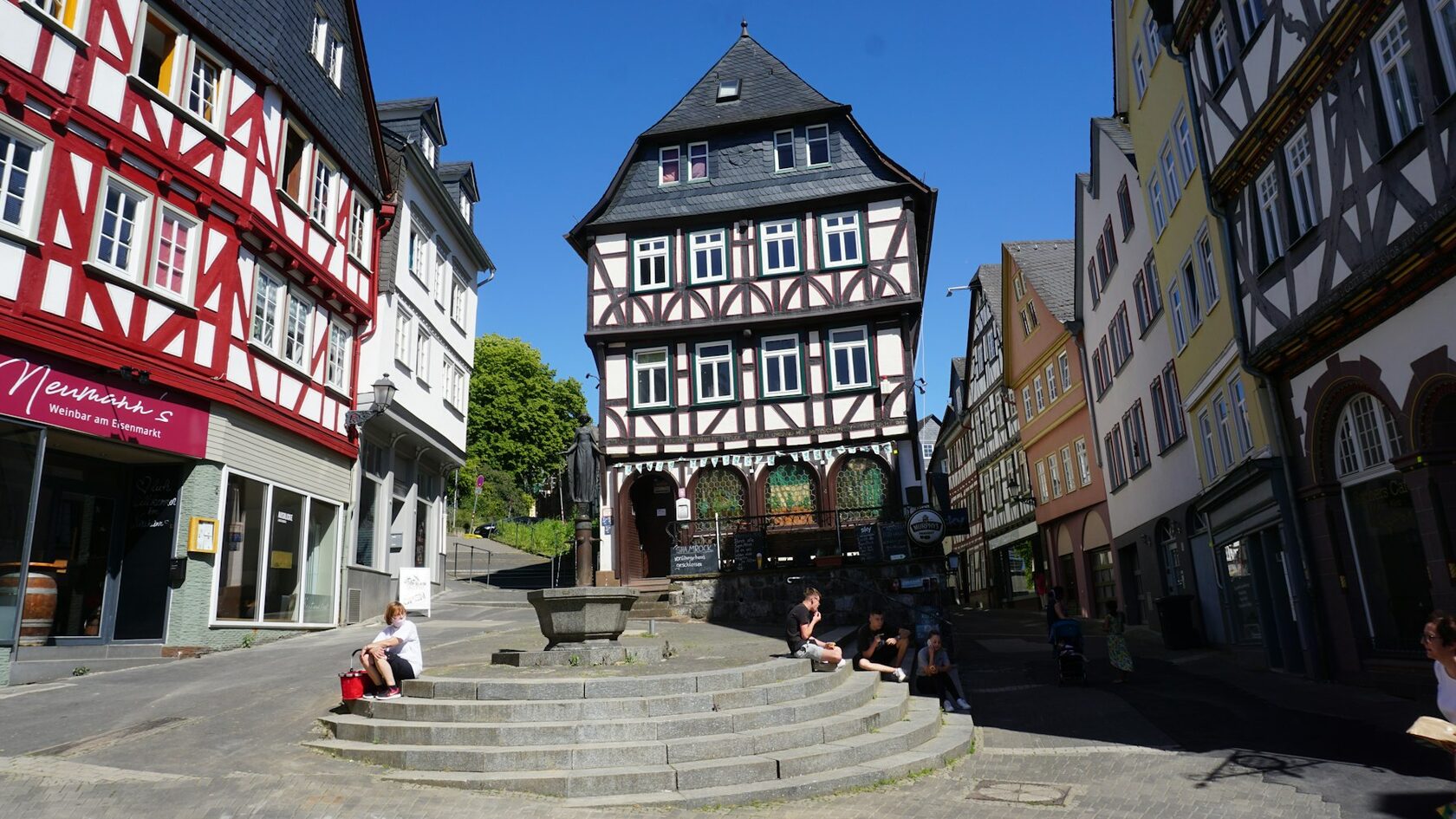
Wetzlar is the smallest of Hesse's ten regional centres (Oberzentren): it had 54,865 residents at the end of 2025, whereas the status usually goes to cities of 100,000 or more. A buyer of a store here therefore acquires a share not of a town market but of a district market: the Lahn-Dill district has 253,439 residents. The decisive question is how much of that market is actually open to a supermarket.
Wetzlar is smaller than Hesse's other regional centres, but growing
According to the Hesse State Statistical Office (HSL), Wetzlar had 54,865 residents on 31 December 2025, 200 more than a year earlier (+0.4%). The Lahn-Dill district as a whole, including the town, had 253,439. Of the ten regional centres named in Hesse's state development plan (Landesentwicklungsplan, LEP), Wetzlar is the smallest: the next in size, Fulda, has 65,755 residents. The LEP's explanatory statement usually links this status to cities of 100,000 or more and allows exceptions if the region's supply is assured.
Wetzlar is a centre of the optical industry with a long history and home to the headquarters of Leica Camera AG. The town lies on the A 45 Dortmund–Aschaffenburg and A 480 motorways, and the B 49 federal road runs through it.
A regional centre's market extends beyond the town itself
Regional-centre status at this size means that the town supplies more than its own residents: 253,439 people live in the Lahn-Dill district, including Wetzlar. In our estimate, shoppers from the district account for a substantial share of the turnover of the town's stores. For Hesse as a whole, NIQ gives an overall purchasing-power index of 102.4 for 2026.
Exhibit 1. A town of 54,865 residents supplies a district of 253,439 people
Sources: HSL; LEP Hessen; NIQ; Hesse's law on the real estate transfer tax rate.
An investor buys into a district market, not a town market
For a supermarket, regional-centre status is a mixed signal. It speaks to the town's pull as a shopping destination, but in our experience people buy food closer to home. A supermarket's catchment is therefore narrower than that of the specialist stores in the centre: part of the district's demand goes to stores in the Lahn-Dill municipalities, not to the town.
Three LEP objectives set the planning framework. Under objective 6-1, a large-scale store is permitted in a regional centre such as Wetzlar; under objective 6-3, its special zone must, as a rule, lie in an integrated urban location. Under objective 6-4, it must not impair the supply areas of neighbouring municipalities. Central Hesse has two more regional centres, Giessen and Marburg, and each holds on to its share of regional demand. Population growth of 0.4% argues for the town, but it is no substitute for analysing the specific catchment.
Implications for investors
1. Size the store's market from its neighbourhood, not the district. The district market of 253,439 residents is only partly open to a supermarket: find out what share of turnover comes from residents of the neighbourhood and what share from shoppers from outside.
2. Compare the store with competitors in the district's municipalities. Part of the district's demand goes to stores in the Lahn-Dill municipalities, so check every competitor within a ten-minute drive.
3. Test the site against LEP objectives 6-1, 6-3 and 6-4. Whether the store stands in an integrated location and whether it impairs the supply areas of neighbouring municipalities determine its room to extend.
What to check:
• what share of the store's turnover comes from residents of its neighbourhood and what share from shoppers from outside;
• the development plan (Bebauungsplan): special zone, maximum sales area and room to extend in light of LEP objectives 6-1, 6-3 and 6-4;
• competitors within a ten-minute drive, including in the municipalities of the Lahn-Dill district;
• whether the town has a current retail concept (Einzelhandelskonzept) and how it classifies the site;
• purchasing-power and retail-centrality indices for the catchment: request them from a broker or the local chamber of commerce (IHK);
• the 6.0% real estate transfer tax in the price and yield calculation: €300,000 on a €5 million deal.
See also: Commercial property in Giessen; Commercial property in Marburg; How do you choose a town to buy a supermarket in Germany?; Landesentwicklungsplan (state development plan); Real estate transfer tax in Germany 2026: rates by state.
Sources: Hessisches Statistisches Landesamt, "Bevölkerung in Hessen am 31. Dezember 2025" (July 2026); Landesentwicklungsplan Hessen 2000 as amended by its fourth amendment (GVBl. 2021 p. 394), section 5.2.1-2 with explanatory statement, objectives 6-1, 6-3, 6-4; NIQ, Kaufkraft Deutschland 2026; Wikipedia, "Wetzlar" and "Leica Camera" articles (October 2026); Hesse's law on the real estate transfer tax rate. Legal position as of October 2026.
Photo: Georg Pflueger / Unsplash
This page is general information and not investment, legal or tax advice.