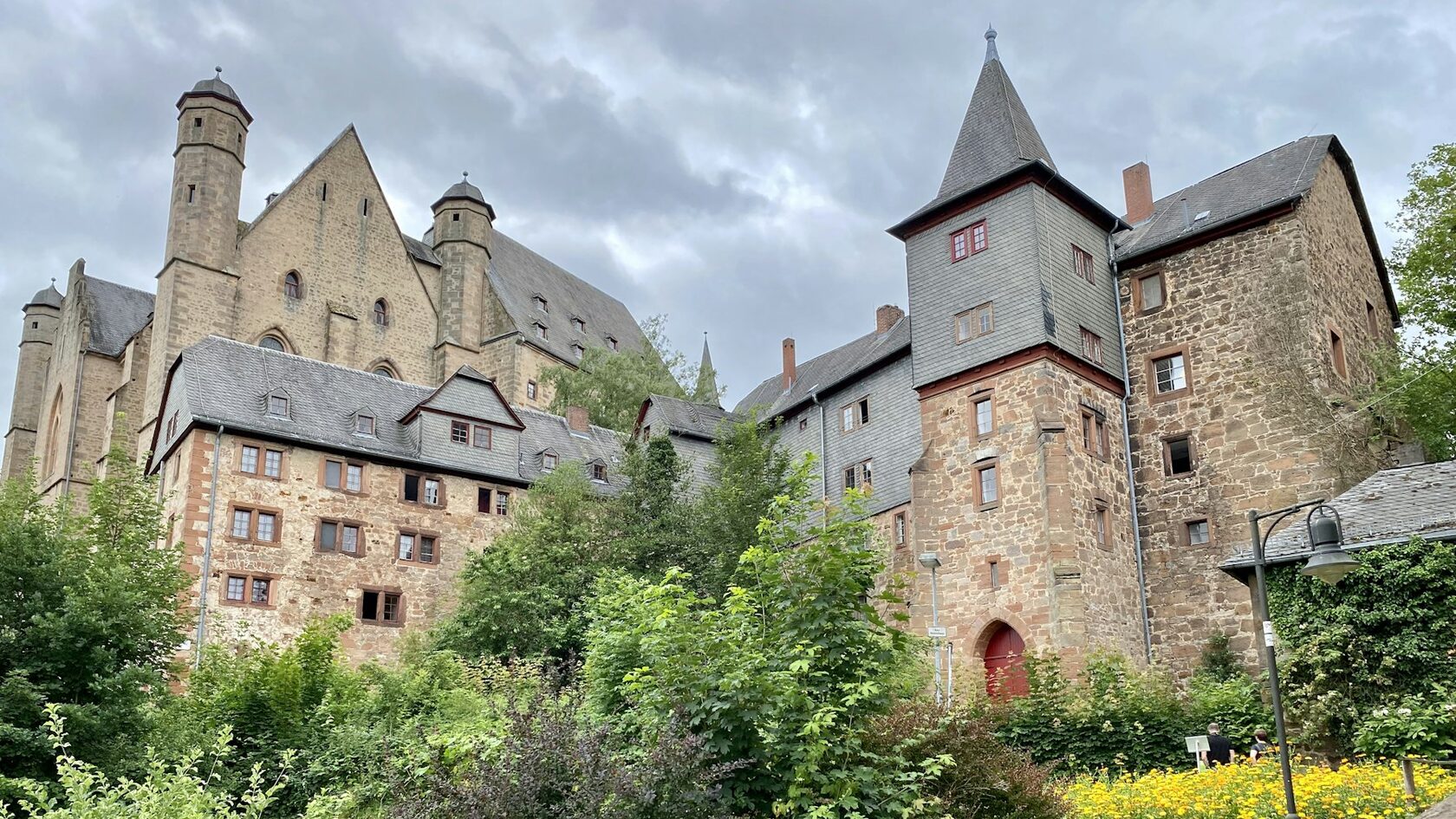
Food retail in Marburg has room to grow, but only where the new retail concept (Einzelhandelskonzept), adopted by the city council on 21 November 2025, allows it. According to the concept, food occupies about 31,100 m² of sales area in the town, or about 0.42 m² per resident, against a national average of about 0.44 m². In this university town and regional centre (Oberzentrum) of 73,571 residents (end of 2025), a store's value depends largely on its site's category in the concept.
Marburg's population is stable, and the university carries the town
Marburg's population is stable. According to the Hesse State Statistical Office (HSL), the town had 73,571 residents on 31 December 2025, 27 more than a year earlier. The Marburg-Biedenkopf district as a whole, including the town, had 242,751. The Hessian state development plan (Landesentwicklungsplan, LEP) counts Marburg among the three regional centres of Central Hesse, together with Giessen and Wetzlar.
The university is the town's mainstay. Philipps University of Marburg had 20,899 students in the 2025/26 winter semester and 3,974 staff (December 2024). The university hospital UKGM and pharmaceutical companies, including CSL Behring, also operate in the town. Marburg is served by the B 3, B 62, B 252 and B 255 federal roads, and the Main-Weser-Bahn railway links it with Frankfurt am Main and Kassel.
The 2025 concept sees growth potential in food retail
CIMA, the consultancy that drafted the concept, sees some development potential in food retail. Overall retail centrality in Marburg is about 119%: more purchasing power flows into the town than leaves it. For food the figure is 95%, and sales area per head is below the national average. The town's purchasing-power index, on which the concept bases its calculation, is 88.3 (MB-Research, 2024); for Hesse as a whole, NIQ gives an index of 102.4 for 2026.
Exhibit 1. Marburg has less food sales area per resident than the national average: about 0.42 m²
Sources: HSL; Philipps-Universität Marburg; CIMA, Marburg retail concept 2025 (purchasing-power index: MB-Research); Hesse's law on the real estate transfer tax rate.
Stores may grow only where the concept allows it
Once adopted, the concept serves as an urban development concept (städtebauliches Entwicklungskonzept, § 1(6) no. 11 BauGB). The town takes it into account in every change to its retail and is gradually transferring its rules into development plans (Bebauungspläne).
The rules for food stores are tiered. Stores with a mainly food range are permitted, in principle, in the town centre, two sub-centres and five local-supply areas (Nahversorgungsbereiche), but large projects that could harm local supply are assessed case by case. In other integrated locations, a new food store is allowed if it fills a gap in local supply and passes the same assessment. At large-format specialist-store sites (Fachmarktstandorte) and in non-integrated locations, new food stores are, in principle, not permitted, except small ones of up to 100 m². Existing stores there may be extended after a case-by-case assessment.
The tegut ruling closed a site in the district to EDEKA
Under the Federal Cartel Office (Bundeskartellamt) decision of 28 September 2026, EDEKA may neither buy nor lease 24 tegut sites for four years; one of them is the store in Kirchhain, in the Marburg-Biedenkopf district. The owner of such a property needs a tenant outside the EDEKA group (see "tegut as a tenant").
Implications for investors
1. Establish the site's category in the 2025 concept. A store's value depends largely on it: food retail in Marburg can grow, but only where the concept allows.
2. Find out in advance whether a case-by-case assessment will be needed. It applies to large projects that could harm local supply and to a new store in other integrated locations. At specialist-store sites and in non-integrated locations, extensions of existing stores also go through it.
3. For a tegut store, find out who will become the tenant. The Kirchhain site is among the 24 that EDEKA may neither buy nor lease for four years.
What to check:
• the site's category in the 2025 concept: centre, sub-centre, local-supply area, other integrated location or specialist-store site;
• whether an extension will need an assessment of its impact on the centre and the supply areas;
• the development plan (Bebauungsplan): special zone, maximum sales area, permitted range of goods;
• for a tegut store, who will become the tenant and whether the site is on the excluded list;
• purchasing-power and retail-centrality indices for the catchment (NIQ, MB-Research): they are sold under licence, so request them from a broker or the chamber of commerce (IHK Kassel-Marburg);
• the 6.0% real estate transfer tax in the price and yield calculation: €300,000 on a €5 million deal.
See also: Commercial property in Giessen; tegut as a tenant; Landesentwicklungsplan (state development plan); Real estate transfer tax in Germany 2026: rates by state; How do you choose a town to buy a supermarket in Germany?
Sources: Hessisches Statistisches Landesamt, "Bevölkerung in Hessen am 31. Dezember 2025" (July 2026); CIMA Beratung + Management GmbH, "Einzelhandelskonzept für die Universitätsstadt Marburg 2025" (20 October 2025; adopted by the Stadtverordnetenversammlung on 21 November 2025); Philipps-Universität Marburg, Zahlen und Fakten; Landesentwicklungsplan Hessen 2000 as amended by its fourth amendment (GVBl. 2021 p. 394), section 5.2.1-2; Bundeskartellamt, press release of 28 September 2026; NIQ, Kaufkraft Deutschland 2026; Wikipedia, "Marburg" article (transport, companies; October 2026); Hesse's law on the real estate transfer tax rate. Legal position as of October 2026.
Photo: Pieter van de Sande / Unsplash
This page is general information and not investment, legal or tax advice.