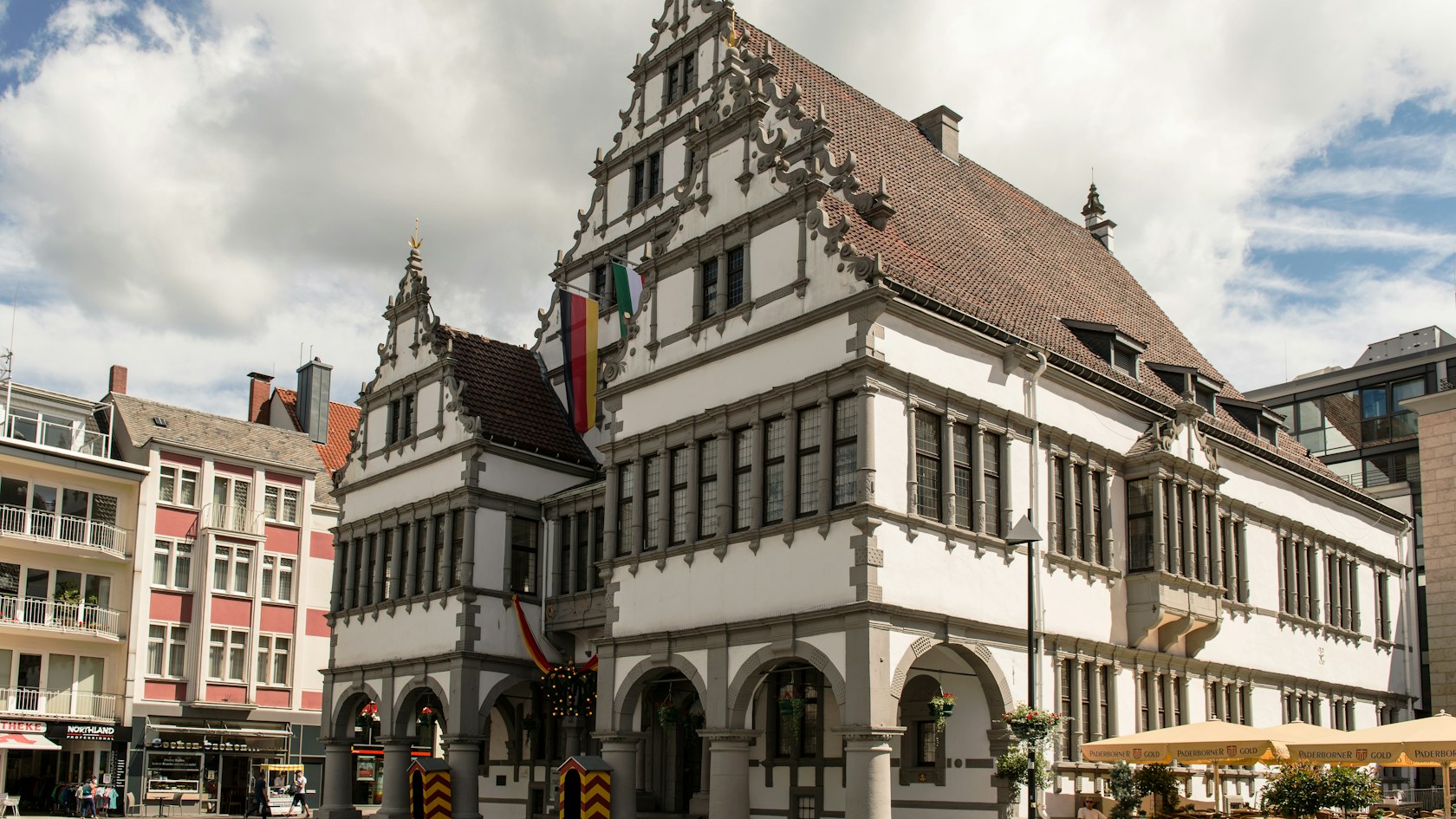
Paderborn gives a supermarket a stable volume of demand in which shoppers' age matters more than average income. This regional centre (Oberzentrum) in the east of North Rhine-Westphalia had 155,906 residents at the end of 2025, almost 16,000 university students and 17,373 more people commuting in to work than out. Disposable income per head is lower than in the surrounding district, but a model calculation by the state statistics office IT.NRW puts the population decline to 2050 at only 1.0%.
Paderborn lives on its university and technology companies
The university, with 15,946 students (May 2026), gives Paderborn a young profile. The city is home to the headquarters of dSPACE, a developer of solutions for simulating and validating electronic systems, including for automated driving. Diebold Nixdorf, a technology supplier to banks and retailers, runs its German holding company here (the group is headquartered in the US state of Ohio). The production sector (manufacturing and construction) employs 20.2% of the 82,605 employees in the city itself and 28.5% in the district of Paderborn (end of 2024, IT.NRW).
The city draws workers from the surrounding area: 41,075 residents of other municipalities commute in, while 23,702 commute out of Paderborn (30 June 2024). The A33 motorway links the city to the A2 and A44, Intercity trains serve the main station on routes to Kassel and Hamm, and an express bus connects the station with Paderborn/Lippstadt airport.
Exhibit 1. Paderborn barely loses residents (−1.0% by 2050) and draws in workers (+17,373)
Sources: IT.NRW (population, model calculation, municipal profile); LEP NRW, Annex 1; NRW law on the real estate transfer tax rate.
Low average income here reflects a young population
By disposable income per head, Paderborn ranks only 333rd of the state's 396 municipalities: €23,676 (2022), against €25,097 in the district and €25,100 in the state (IT.NRW). In a university town such a gap is to be expected: students add to the head count more than to income. People aged 18 to 29 make up 17.8% of Paderborn's residents, against a state average of 13.6% (end of 2024, IT.NRW). For a supermarket, this argues for formats built for frequent small purchases and price-sensitive shoppers, not for a premium basket.
Demography is Paderborn's strength. IT.NRW calculates that the state will lose 2.7% of its residents by 2050, while the city will keep almost its present population. It thereby meets the third condition set out in Part 5 of the series German Prime Retail: a stable catchment.
Regional-centre status does not lift the siting rules
Regional-centre status does not exempt a store from the limits of the state development plan (Landesentwicklungsplan, LEP NRW). The plan classes food as a range relevant to town centres and to local supply in residential areas. A large-scale food store (§ 11(3) BauNVO) is therefore permitted, in principle, only in a central supply area (zentraler Versorgungsbereich), and elsewhere only by way of exception (objective 6.5-2). An existing store outside a central supply area is, as a rule, confined to the area protected by grandfathering (Bestandsschutz); it can be extended only slightly, and only by way of exception (objective 6.5-7).
The rules may soften. On 2 September 2026 the state government approved a draft third amendment to the LEP. It introduces an exception for local-supply stores with a total sales area of up to 1,200 m² on sites designated in the municipal retail concept (Einzelhandelskonzept). The amendment takes effect only with the consent of the state parliament (Landtag).
The real estate transfer tax raises the cost of entry: the state charges 6.5%, or €650,000 on a €10 million price.
Implications for investors
1. Judge demand by the number and age of shoppers, not by average income. Low income per head here reflects the share of students: the city barely loses residents and draws in workers.
2. Check that the format suits a young catchment. Shoppers' age argues for formats built for frequent small purchases and price-sensitive customers, not for a premium basket.
3. Test the site against Paderborn's retail concept. Even in a regional centre, a large-scale food store is permitted, in principle, only in a central supply area. If the Landtag approves the third LEP amendment, local-supply sites in the same concept will become more accessible to stores of up to 1,200 m².
What to check:
• the site's place in Paderborn's retail concept: a central supply area, a local-supply site, or neither;
• the development plan (Bebauungsplan): maximum sales area and room to extend under LEP NRW objective 6.5-7;
• the share of students and young shoppers in the catchment, and whether the store's format suits them;
• competitors within a ten-minute drive and projects that the third LEP amendment could ease;
• the 6.5% real estate transfer tax in the price and yield calculation.
See also: Metropolis or market town (Part 5 of the series German Prime Retail); Commercial property in Bielefeld; Commercial property in Lippstadt; Real estate transfer tax in Germany 2026: rates by state.
Sources: IT.NRW: Bevölkerungsstand am 31.12.2025 (statistik.nrw), Kommunalprofil Paderborn (as of 15 January 2026); LEP NRW, Annex 1, objectives 6.5-2 and 6.5-7 (as amended on 9 April 2024); draft third amendment to the LEP NRW (state government decision of 2 September 2026); § 11(3) BauNVO; Universität Paderborn (website, May 2026); dSPACE Group SE & Co. KG; Diebold Nixdorf, Incorporated; NRW law on the real estate transfer tax rate (GV. NRW. 2014 p. 954); the series German Prime Retail, Part 5. Legal position as of October 2026.
Photo: Wolfgang Weiser / Unsplash
This page is general information and not investment, legal or tax advice.