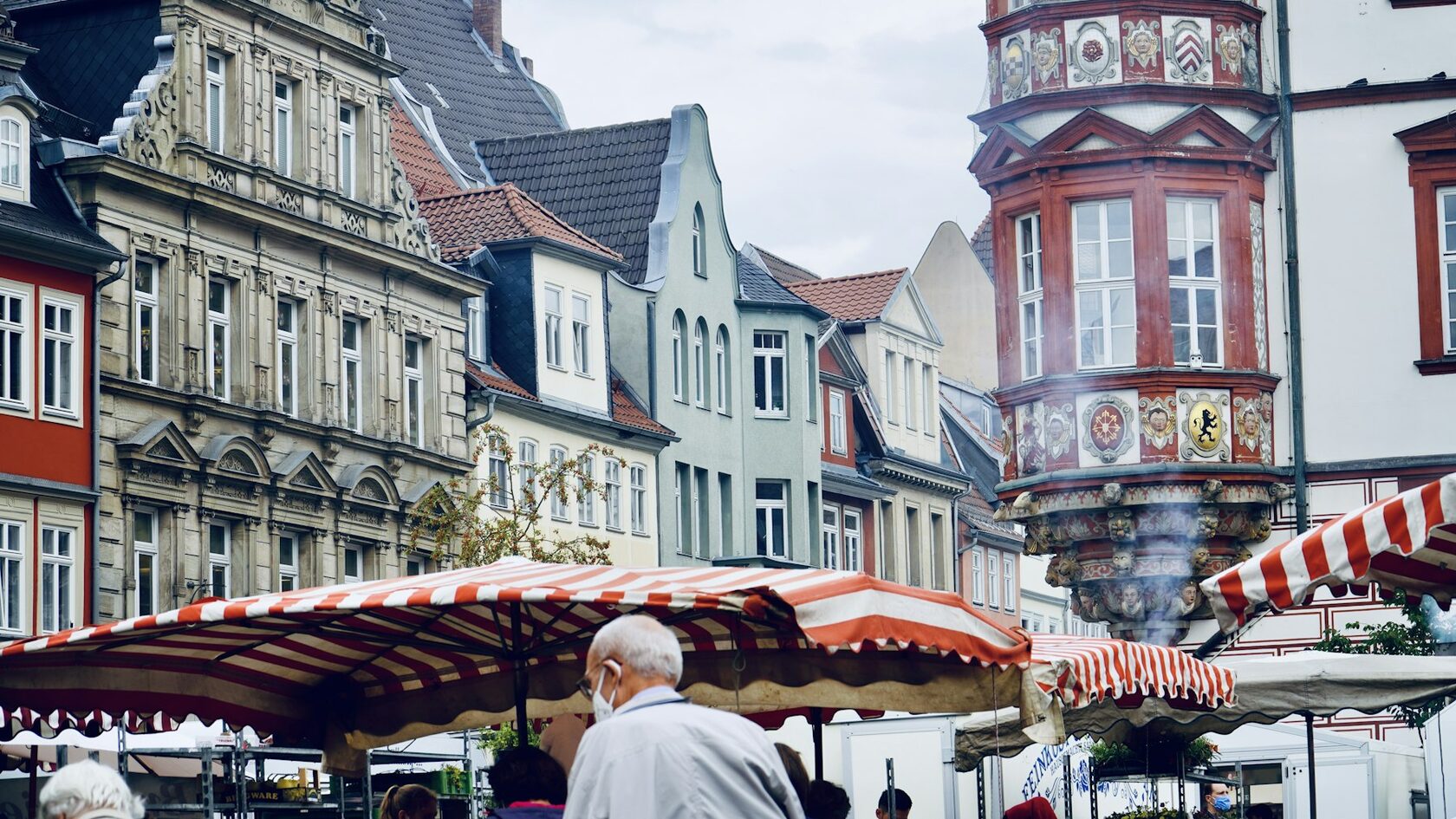
Coburg has just 40,970 residents (Destatis, end of 2025), but the city's economic development agency puts the catchment of this regional centre (Oberzentrum) at about 300,000 people. Every day 16,540 more people commute into Coburg than out of it, and Bavaria's real estate transfer tax (Grunderwerbsteuer) is the lowest in Germany, at 3.5%. The flip side is a dependence on a few employers and the proximity of Thuringia, where both the transfer tax and the rules for large stores differ.
Coburg's prosperity rests on a handful of large employers
Coburg is a prosperous district town in northern Bavaria (see Part 4 of the series German Prime Retail), and its wealth hangs on a few companies. The insurance group HUK-COBURG moved its headquarters here in 1950; in 2025 it had 11,942 employees, and it describes itself as Germany's largest car insurer, with about 14.5 million insured vehicles. The automotive supplier Brose is also registered in Coburg: about 33,000 employees at 75 sites in 24 countries, and revenue of €7.9 billion in 2025. The chamber of commerce IHK zu Coburg calls the city a centre of the finance industry, and above all of insurance, in northern Bavaria.
The jobs draw people from the surrounding area: according to the Federal Employment Agency (June 2023), 23,853 workers commute into the city every day and 7,313 commute out. In its review of purchasing power for 2026, NIQ named Coburg among the districts with the fastest gains, thanks to a strong Mittelstand of mid-sized firms.
The city itself is small and lost 94 residents (−0.23%) in 2025; another 83,687 people live in the district of Coburg. The A 73 motorway and ICE trains connect it with the rest of the country: according to the city, the train takes 2 hours 23 minutes to Berlin and 2 hours 12 minutes to Munich.
The Thuringian border widens the market but changes the rules
The city describes itself as a regional centre on the border between Upper Franconia and South Thuringia, and as the link between Upper Franconia and Thuringia. If some of a store's shoppers live across that border, two differences come into play. In Thuringia the transfer tax is 5.0% instead of Bavaria's 3.5%: on a €10 million price, €500,000 against €350,000. And large stores there are governed by Thuringia's state development programme, not Bavaria's.
On the Bavarian side, the state development programme (Landesentwicklungsprogramm, LEP Bayern) applies: a store for everyday needs with up to 1,200 m² of sales area is permitted in any municipality (objective 5.3.1). A larger project may absorb no more than 25% of the purchasing power for its range in the reference area (objective 5.3.3).
Exhibit 1. Coburg has 40,970 residents but, by the city's estimate, a catchment of about 300,000
Sources: Destatis; LEP Bayern; Wirtschaftsförderungsgesellschaft der Stadt Coburg; HUK-COBURG; Brose.
Implications for investors
1. Assess the catchment, not the size of the town. A small town need not mean a small market: every day 16,540 more people commute into Coburg than out of it, and the city puts its catchment at about 300,000 people.
2. Test whether the catchment will hold its population. A supermarket's sales volume follows above all the number of people, not their income (see Part 5). The city's prosperity, however, depends heavily on a few employers in insurance and the car industry.
3. Choose a dominant site with room to expand. The store's position will decide its value: such a site is worth more than a secondary one, provided the extension stays within the Bavarian 25% cap.
What to check:
• what share of the store's shoppers come from Thuringia and from the surrounding municipalities of the district of Coburg;
• the population forecast for the city and the district, from the Bavarian State Office for Statistics;
• competitors within a ten-minute drive on both sides of the state border;
• whether the planned extension stays within the 25% cap on the reference area's purchasing power (objective 5.3.3 of LEP Bayern);
• purchasing-power and retail-centrality indices for the catchment (NIQ, MB-Research): they are sold under licence, so request them from a broker or the chamber of commerce (IHK zu Coburg);
• the lease: remaining term, options and the tenant's own investment in the store.
See also: Commercial property in Bamberg; Commercial property in Erfurt; Landesentwicklungsplan (state development plan); Real estate transfer tax in Germany 2026: rates by state.
Sources: Destatis, Gemeindeverzeichnis-Informationssystem (GV-ISys), data as of 31 December 2024 and 2025; Landesentwicklungsprogramm Bayern, objectives 5.3.1, 5.3.3 and Annex 1 (gesetze-bayern.de, October 2026); IHK zu Coburg, "Standortinformationen" (October 2026); NIQ, Kaufkraft Deutschland 2026 (14 January 2026); Wirtschaftsförderungsgesellschaft der Stadt Coburg, "Standort" section and "Wirtschafts- und Standortbroschüre" (2024; commuter data: Federal Employment Agency, June 2023); HUK-COBURG, "Fakten & Historie" (October 2026); Brose, "Unternehmen" section (October 2026); § 11(1) GrEStG; Thuringian law on the real estate transfer tax rate (as amended on 22 September 2023); German Prime Retail series, Parts 4 and 5.
Photo: Viva Zhang / Unsplash
This page is general information and not investment, legal or tax advice.