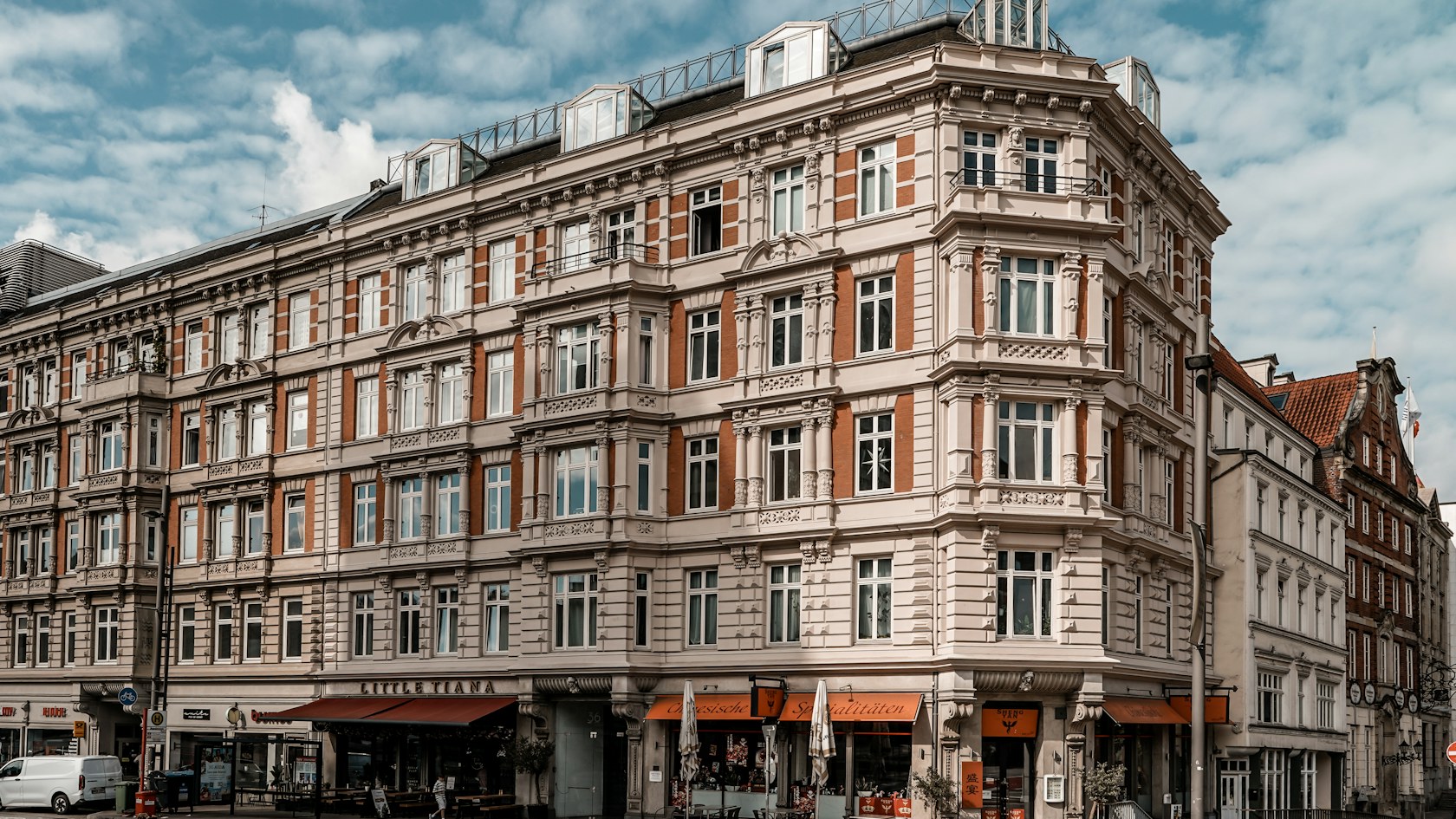
In a supermarket with flats — a building with a food store on the ground floor and rented flats above it — the investor acquires a commercial lease and residential tenancies, which German law regulates differently. One example is ALDI Süd, which in 2025 replaced a 1987 store in Nuremberg with a five-storey building that has 56 rental flats above a 1,150 m² sales floor. BNP Paribas Real Estate publishes neither the number of such properties nor their yields.
The chains promote the format themselves where land is scarce
The chains themselves offer mixed-use buildings. Beneath ALDI Süd's Nuremberg building is a two-level underground car park with 112 spaces. For plots of 3,000 m² or more, Lidl offers a format for large cities (Metropolfiliale): parking on the ground floor, the sales floor above it, and above that, floors for flats, offices and co-working. Kaufland offers to place flats, offices, social facilities or medical centres above the store, and Netto and Penny have built mixed use into their concepts.
Some funds accept housing only together with a food anchor. In Habona's open-ended fund, flats were permitted only in combination with a food store, with a target share of 10% of the portfolio (2023 presentation).
In our view, the format's main economic feature is that the store cannot grow: the flats above it fix its area for the life of the building. The "silent reserve" of enlargement therefore does not work here (see Part 3 of the series German Prime Retail).
The store and the flats live by different rules
Exhibit 1. The store's rent follows the lease, the flats' rent the law — with increases capped at 20% in three years
The 5% declining-balance depreciation is not available to everyone: it can be claimed by whoever built the building or bought it by the end of the year of completion, and only for the residential part. The same rules apply to self-contained parts of a building and to flats and non-residential units held in separate ownership (§ 7(5b) EStG).
Yield is calculated by part; a divided building sells more easily
The sources publish no separate yield for such buildings. The 5.00% for standalone supermarkets and discounters (BNP Paribas Real Estate, Q3 2026) cannot be applied to the whole building: the residential part follows its own market and its own rules.
The law allows the building to be divided into separate ownership of non-residential units (Teileigentum) and of flats (Wohnungseigentum), each with a share in the common property (§ 1 WEG). Lidl expressly allows such a division for its large-city format, and the store and the flats can then be sold to different buyers. Without a division, in our experience, the buyer has to want both retail and housing, and such buyers are fewer.
The format carries three risks. Deliveries and refrigeration plant make noise beneath residents' windows. The roof, structure and building services are shared, and their costs must be allocated between the leases in advance. And housing takes more work to manage.
Implications for investors
1. Calculate the yield separately for the store and for the flats. The 5.00% benchmark for standalone supermarkets and discounters does not carry over to the whole building: housing has its own market and rules, from rent caps to the VAT exemption.
2. Check the division into Teileigentum and Wohnungseigentum before you buy. A division lets the store and the housing be sold to different buyers; without one, in our experience, the buyer has to want both retail and housing, and such buyers are fewer.
3. Do not price in an enlargement of the store. In our view, the flats above it fix its area for the life of the building, and the supermarket's "silent reserve" does not work here.
What to check:
• Check whether the building has been divided into Teileigentum and Wohnungseigentum, or whether it can be.
• Find out whether the municipality lies in a designated area with a tight housing market, and when the flats were first let — before or after 1 October 2014.
• Check how input VAT and operating costs are split between the store and the flats.
• Read the permit's conditions on delivery hours, noise and the allocation of parking between shoppers and residents.
• Establish who is responsible for the roof, structure and shared building services under the store lease and in the service-charge statements to residents.
See also: Discount store as an investment; Full-range supermarket as an investment; Choosing the ownership structure and tax (see Part 9 of the series German Prime Retail).
Sources: ALDI SÜD, Nuremberg project page (2025) and the page "Filialkonzepte"; Lidl, the page "Metropolfiliale"; Kaufland, the page "Filialkonzepte"; Netto Marken-Discount, expansion brochure 2026; Penny, expansion brochure 2026; Habona Invest, presentation of the Habona Nahversorgungsfonds Deutschland, November 2023; BNP Paribas Real Estate, retail investment market report, Q3 2026; BGB §§ 556d, 556f, 557b, 558, 573, 575; UStG § 4 no. 12, § 9(1), (2), § 15(2); EStG § 7(4), (5a), (5b); WEG § 1; German Prime Retail series, Parts 3 and 9; Gordon Real Estate Group experience. Law as at 10 October 2026.
Photo: Wolfgang Weiser / Unsplash
This page is general information and not investment, legal or tax advice.