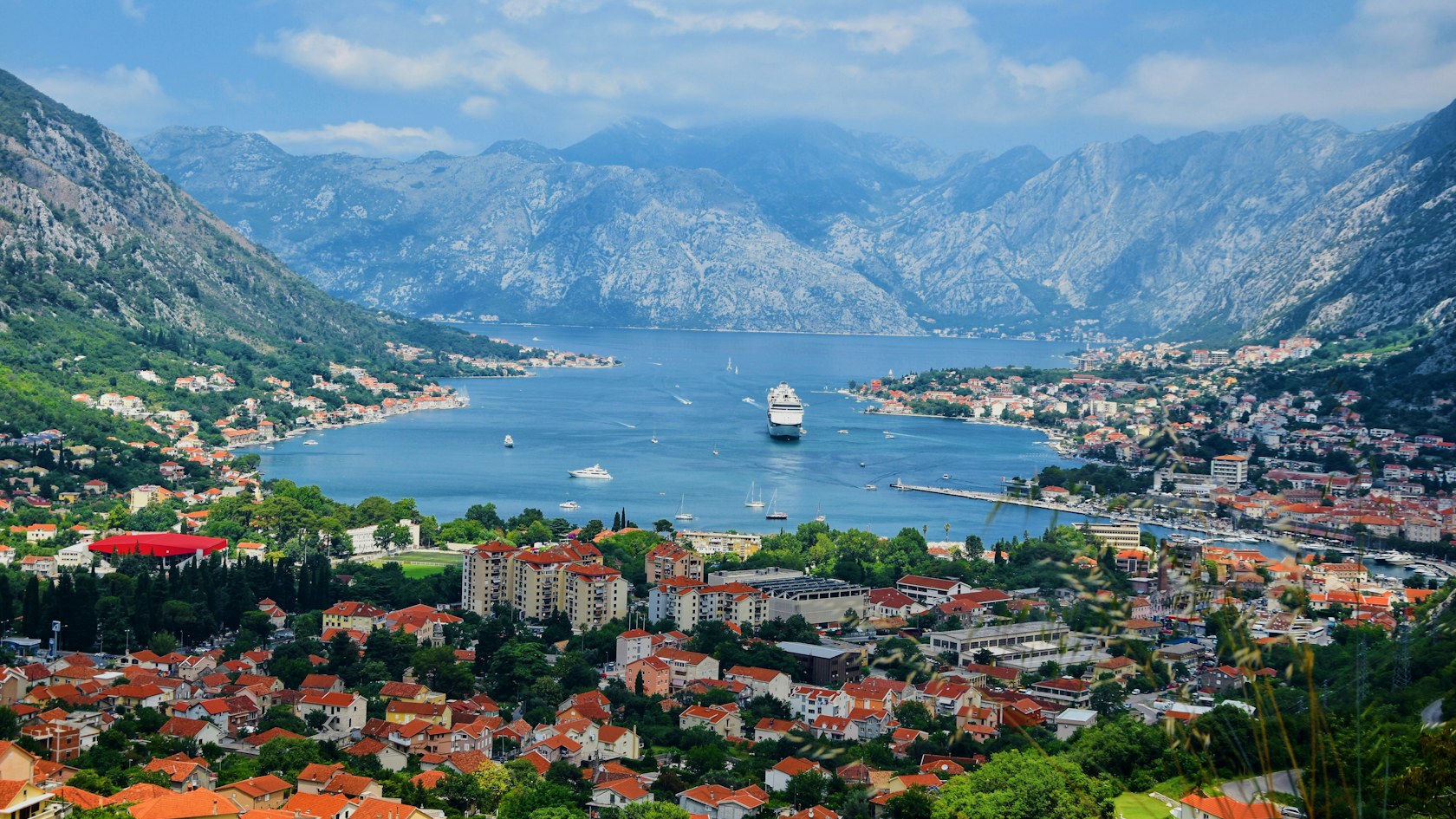
There is no single answer: Germany offers a measurable euro yield of 5.00% on prime supermarkets, Montenegro the euro without euro-area membership and a temporary residence permit that owners of property worth €150,000 or more can obtain. In the World Justice Project's rule-of-law index, Germany ranks 6th of 143 countries and Montenegro 55th. We found no published yield on Montenegrin commercial property from a major broker, and Montenegro's transfer tax is progressive: from 3% to 6%, or about 5.8% at a price of €5 million.
Exhibit 1. Germany offers a measurable 5.00% and 6th place in the WJP index, Montenegro the euro without the euro area and 55th place
Germany publishes a yield; Montenegro has no comparable figure
Germany offers a measurable benchmark: the net initial yield on prime supermarkets and discounters was 5.00% in Q3 2026 (see Part 1 of the series German Prime Retail). For Montenegro we found no comparable published figure from a major broker: Cushman & Wakefield CBS publishes no yield in the latest market report we found, for H1 2024.
The cadastre is open but incomplete; foreigners buy on broadly equal terms
Transactions and mortgages are recorded in the real estate cadastre. According to the US State Department, the system is largely digitised and open to the public, but more than 10% of land, mainly rural and mountainous, lacks clear or registered title. The World Justice Project's 2025 index shows the overall legal gap: Montenegro ranks 55th of 143 countries, Germany 6th.
Foreigners buy broadly on the same terms as citizens, but even EU and EEA citizens face restrictions on agricultural land (European Commission, 2025). Montenegro is not an EU member — it is negotiating accession — but, according to the European Commission, it has fully aligned with all EU restrictive measures against Russia and Belarus. Germany has no restrictions by citizenship, but the EU sanctions regulations themselves apply there, as does the EU list of high-risk third countries, which has included Russia since January 2026.
The owner of a property — a flat, house, hospitality facility or business premises — or a co-owner of at least half may obtain a temporary residence permit (Art. 56 of the Law on Foreigners). This requires meeting the general conditions and a transfer tax base of at least €150,000. The citizenship-by-investment programme closed on 31 December 2022. In Germany buying property gives no right to a residence permit.
The transfer tax rises with the price: about 5.8% at €5 million
The buyer pays transfer tax on the market value; the return is due within 15 days. The rate is 3% up to €150,000, 5% on the portion from €150,000 to €500,000 and 6% above €500,000 (Arts 7 and 11 of the Law on Real Estate Transfer Tax). At a price of €5 million the tax comes to €292,000, or about 5.8% (our calculation). New buildings and, from 1 April 2026, building plots sold with VAT (21%) are exempt from it. A company that owns property pays an annual property tax of 0.25–1% of market value.
In Germany the real estate transfer tax (Grunderwerbsteuer) is 3.5–6.5%, depending on the federal state. With the notary, the land register (Grundbuch) and the broker's commission, acquisition costs reach about 4.5–11% of the price (Part 11).
Montenegro taxes a non-resident's rent at 15%, local companies at 9–15%
An individual, including a non-resident, pays 15% tax on Montenegrin rent, after documented expenses or a standard deduction of 30%. A corporate tenant paying rent to a foreign company withholds 15% at source, or 30% if the recipient is in a tax haven. A Montenegrin company pays corporate income tax on a scale of 9–15%.
Germany taxes a non-resident's rental income in any case. An individual pays income tax of 14–45% plus the solidarity surcharge (Solidaritätszuschlag). A German limited-liability company (GmbH) pays corporate income tax of 15.825%, including the solidarity surcharge, and trade tax (Gewerbesteuer) unless the extended reduction (erweiterte Kürzung) applies (Part 9).
Individuals pay 15% on capital gains, and the proceeds stay in euros
On a sale, an individual pays 15% on the capital gain — the same rate as on rent. In 2024 Montenegrin real estate attracted €455 million of the country's €890 million of foreign direct investment (US State Department).
For an investor counting in euros, the proceeds need no conversion. However, Montenegro uses the euro as legal tender under a decision taken in exceptional circumstances, and this is not euro-area membership: the country has no standard monetary policy instruments (European Commission, 2025).
Implications for investors
1. Confirm the price with an individual valuation. We found no open benchmark from major brokers for Montenegro: request the yield with date, source and method.
2. Check the property against the cadastre before signing the contract. According to the US State Department, more than 10% of the country's land lacks clear or registered title, and agricultural land is restricted even for EU and EEA citizens.
3. Calculate entry taxes and the tax on rent for your form of ownership. At a price of €5 million the transfer tax comes to about 5.8%; on rent an individual pays 15% after expenses, and a foreign company 15% at source.
What to check:
• the yield and the price — from an individual valuation, with date, source and method;
• an extract from the real estate cadastre (list nepokretnosti): owner, mortgages and restrictions;
• whether the plot is agricultural land;
• whether the sale bears 21% VAT or the 3–6% transfer tax;
• who withholds tax on the rent, and at what rate;
• in Germany, the transfer tax rate in the relevant federal state (Part 11).
See also: Germany or Greece: faster courts versus a lower transfer tax and a golden visa; Germany or Georgia: a measurable yield and stronger rule of law versus a cheaper, simpler entry; Investing in German commercial property from Russia: no general purchase ban, but no treaty protection.
Sources: BNP Paribas Real Estate, German retail market report for Q3 2026; Destatis, press release No. 348 of 30 September 2026; Eurostat, HICP: Germany — flash estimate for September 2026, Montenegro — August 2026 (updated 2 October 2026); World Justice Project, Rule of Law Index 2025; European Commission, Montenegro 2025 Report, SWD(2025) 754 of 4 November 2025; Law of Montenegro on Real Estate Transfer Tax (Arts 6, 7, 9, 11) as amended on 10 March 2026; Law of Montenegro on Foreigners (Art. 56) as amended on 10 March 2026; PwC Worldwide Tax Summaries, Montenegro (checked 7 August 2026); US Department of State, 2025 Investment Climate Statement: Montenegro; Cushman & Wakefield CBS, Montenegro Property Market Report, H1 2024 (no yields published); Council Regulations (EU) No 833/2014 and No 269/2014; Commission Delegated Regulation (EU) 2026/46. Legal position as of October 2026.
Photo: olga brajnovic / Unsplash
This page is general information and not investment, legal or tax advice.