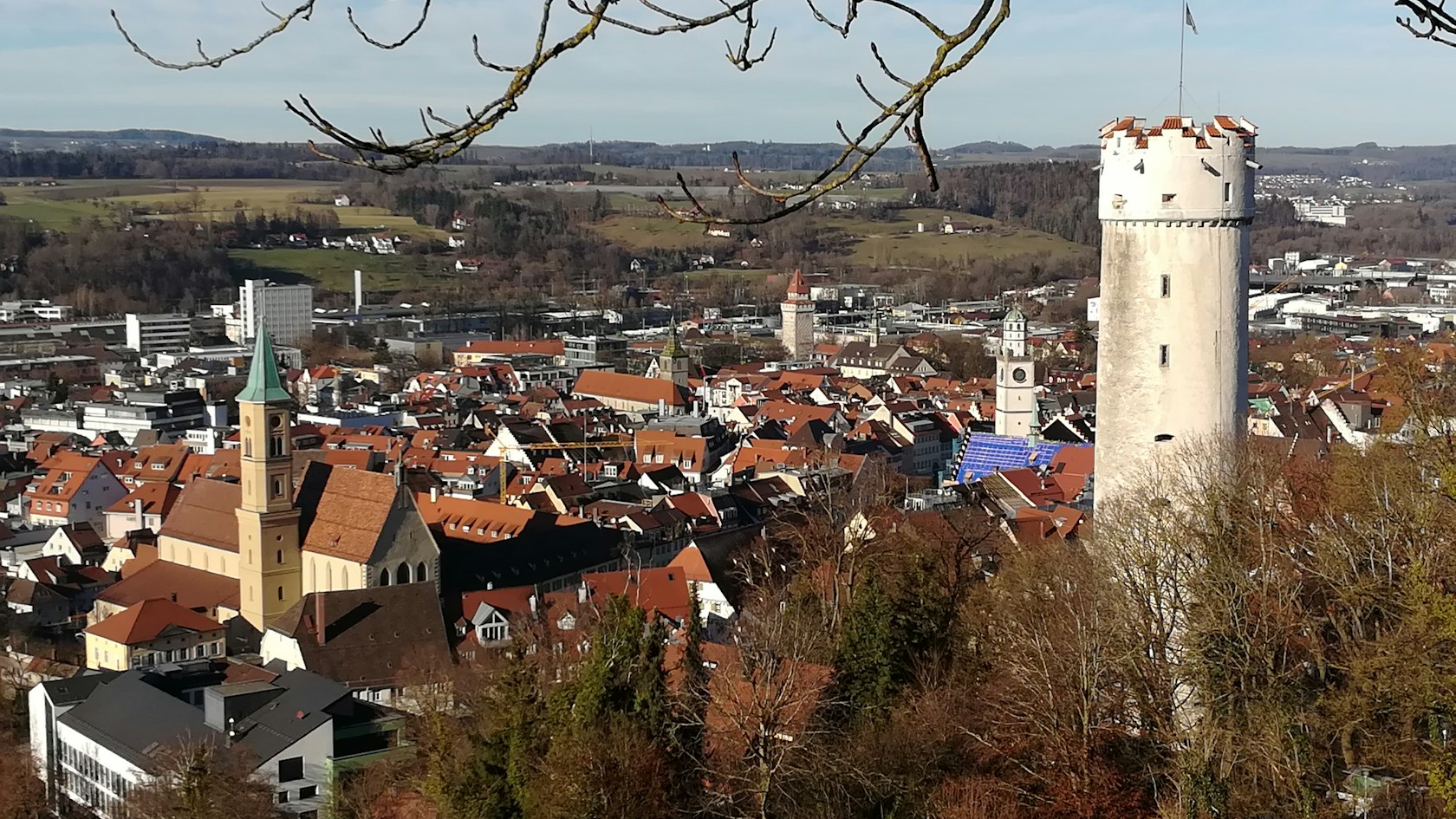
Ravensburg is only part of a regional centre (Oberzentrum): under Baden-Württemberg's state development plan it shares that status with Friedrichshafen and Weingarten. Ravensburg itself has 50,549 residents (Destatis, end of 2025), the three towns together 138,364, and the functions of a regional centre are divided between them. For a supermarket the near catchment matters more, and since open sources do not disclose the town's own purchasing power, it should be commissioned.
Here, regional-centre status is shared between three towns
Baden-Württemberg's state development plan of 2002 (Landesentwicklungsplan, LEP) designates "Friedrichshafen/Ravensburg/Weingarten" as a regional centre (Plansatz 2.5.8). Friedrichshafen (62,781 residents) belongs to the Bodenseekreis district; Ravensburg and Weingarten, a town of 25,034, belong to the district of Ravensburg, whose 39 municipalities are home to 291,600 people (Destatis, end of 2025). The chamber of commerce IHK Bodensee-Oberschwaben calls Ravensburg and Weingarten a joint regional centre and the economic core of the district.
The functions of a regional centre — large-scale retail, hospitals, universities — are spread across the three towns. Ravensburg itself is a town of about 50,000 people, and its population fell by 79, or 0.16%, in 2025. A supermarket's catchment should therefore be measured by the routes shoppers actually take, not by the town's status.
Healthcare, retail and family companies carry the district's economy
According to the IHK, healthcare employs the most people in the district, followed by retail and mechanical engineering. Among the district's well-known companies, the chamber names Ravensburger, Hymer, Dethleffs, Schuler and Vetter. Vetter, a specialist in the aseptic filling of medicines, has its headquarters and production in Ravensburg; by its own account it employs more than 7,400 people worldwide and had revenue of €1.26 billion in 2025.
Ravensburg hosts the business faculty of the Baden-Württemberg Cooperative State University (DHBW Ravensburg), which welcomed about 1,120 first-year students in October 2026. The district is also home to Ravensburg-Weingarten University of Applied Sciences and the University of Education Weingarten. Among transport links, the IHK highlights the B 30 federal road from Ulm to Friedrichshafen and the A 96 Lindau–Munich motorway, which crosses the district. It also cites the Südbahn railway from Ulm to Friedrichshafen and Friedrichshafen airport — but concedes that the roads lag behind the region's economic importance.
Exhibit 1. Ravensburg is only part of the regional centre: 50,549 of its 138,364 residents
Sources: Destatis; LEP Baden-Württemberg 2002; IHK Bodensee-Oberschwaben; NIQ; Vetter; DHBW Ravensburg.
Competition comes from neighbouring towns and small municipalities alike
The shared status means that large projects in Weingarten or Friedrichshafen change the competition for Ravensburg's stores too. The state development plan admits large stores, as a rule, in centres and integrated locations (Plansätze 3.3.7–3.3.7.2), and for basic supply in small municipalities as well. For a supermarket, the near catchment therefore matters more: how far the store dominates its neighbourhood, and how the population is changing.
Implications for investors
1. Measure the catchment by shoppers' routes, not by the town's status. The functions of a regional centre are split between Ravensburg, Weingarten and Friedrichshafen, and Ravensburg's own population fell by 0.16% in 2025.
2. Watch the neighbours' projects. Large projects in Weingarten or Friedrichshafen, and basic-supply stores in small municipalities, change the competition for a Ravensburg store.
3. Commission purchasing-power indices for the store's catchment. There are no open data for the town, so the analysis has to rest on indices that NIQ and MB-Research sell under licence.
What to check:
• purchasing-power and retail-centrality indices for the catchment (NIQ, MB-Research): they are sold under licence, so request them from a broker or the chamber of commerce (IHK Bodensee-Oberschwaben);
• large retail projects in Weingarten and Friedrichshafen, approved or planned;
• the site's zoning and room to expand under Plansätze 3.3.7–3.3.7.2 of the LEP;
• the population forecast for the town and the district;
• the lease: remaining term, options and the tenant's own investment in the store;
• the 5.0% real estate transfer tax in the price and yield calculation: €500,000 on a €10 million price.
See also: Commercial property in Ulm; Zentrale Orte (central places); How do you choose a town to buy a supermarket in Germany?; Landesentwicklungsplan (state development plan); Real estate transfer tax in Germany 2026: rates by state.
Sources: Destatis, Gemeindeverzeichnis-Informationssystem (GV-ISys), data as of 31 December 2024 and 2025; Landesentwicklungsplan Baden-Württemberg 2002, Plansätze 2.5.8, 3.3.7–3.3.7.2; IHK Bodensee-Oberschwaben, "Wirtschaftsraum Bodensee-Oberschwaben" (October 2026); NIQ, Kaufkraft Deutschland 2026 (January 2026); Vetter Pharma, official website (October 2026); DHBW Ravensburg, official website (October 2026); § 1 GrEStFestG BW; German Prime Retail series, Part 5.
Photo: Michael Schreiber / Unsplash
This page is general information and not investment, legal or tax advice.