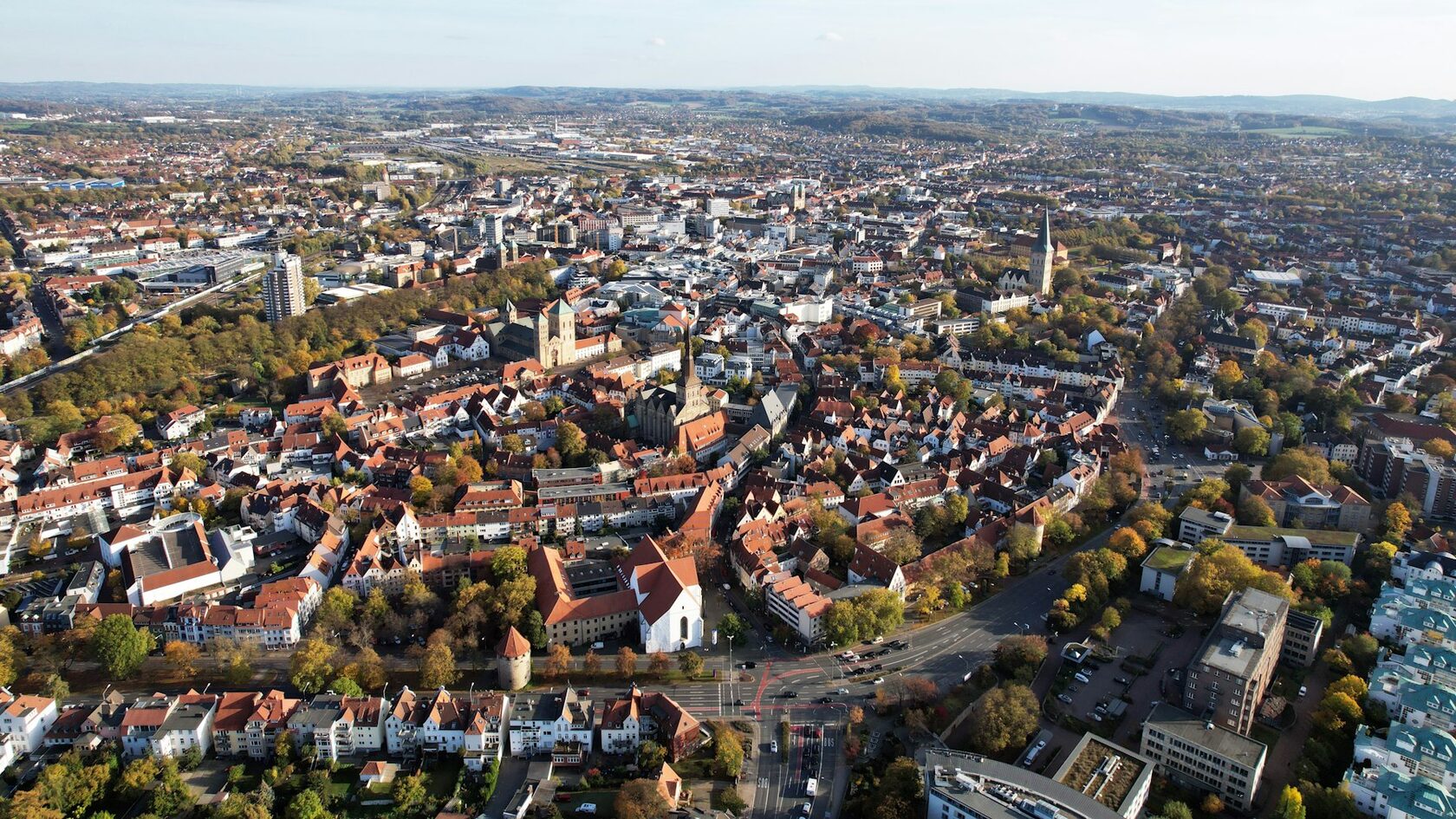
Osnabrück is one of Lower Saxony's eleven regional centres (Oberzentren), with 166,257 residents at the end of 2025 and another 354,130 in the surrounding district. Yet state planning bars a new large grocery store from living off the whole region: if more than 30% of its turnover comes from outside its designated area, it breaches the congruence requirement (Kongruenzgebot). A supermarket's value here therefore rests on the demand of the city and the neighbourhood, not of the district.
Osnabrück is a jobs hub with a slowly growing population
Since 1990 Osnabrück's population has grown by just 1.9% (Lower Saxony: 8.3%), while the number of employees working in the city has risen by 30.6%. In 2025 the city had 166,257 residents and 101,709 employees, according to the Lower Saxony statistical office (LSN) as published by the chamber of commerce IHK Osnabrück-Emsland-Grafschaft Bentheim. Of those employees, 61.3% work in other services, 22.0% in trade, transport and hospitality, and 16.7% in the production sector. We found no purchasing-power figure for Osnabrück itself in open primary sources; for Lower Saxony as a whole, NIQ gives €30,292 per head for 2026, an index of 97.1.
Motorways, rail and a university make Osnabrück the region's hub
Three motorways — the A 1, A 30 and A 33 — surround the city, with the Lotte/Osnabrück and Osnabrück-Süd interchanges. At the main station, built on two levels as a tower station (Turmbahnhof), the Ruhr–Hamburg line crosses a section of the Hanover–Amsterdam route. Osnabrück University has about 14,000 students, and the city also hosts Osnabrück University of Applied Sciences. Hellmann Worldwide Logistics, KME and Felix Schoeller have their headquarters here, alongside the Volkswagen Osnabrück plant.
Exhibit 1. Jobs have outgrown the population since 1990: +30.6% against +1.9%
Sources: IHK Osnabrück-Emsland-Grafschaft Bentheim and Landkreis Osnabrück (LSN data); NIQ; LROP Niedersachsen; Lower Saxony law on the real estate transfer tax rate.
For investors, congruence matters more than the size of the region
Lower Saxony's state spatial planning programme (Landes-Raumordnungsprogramm, LROP) lists Osnabrück as a regional centre (section 2.2, item 04), but its section 2.3 matters more to an investor. In a middle-order centre (Mittelzentrum) or regional centre, the catchment of a new large-scale project selling "periodic" goods — food and drugstore products — must not substantially exceed the basic supply area (grundzentraler Verflechtungsbereich). The excess counts as substantial if more than 30% of the project's turnover comes from purchasing power outside that area. A project whose range is at least 90% periodic goods may stand outside an integrated location only by exception, if it cannot be placed in one. Even then it must lie in the central settlement area, close to housing and on the basis of an urban development concept.
Any new or amended development plan (Bebauungsplan) needed to extend a store must conform to these objectives (§ 1(4) BauGB). A supermarket's room to grow is therefore set by the demand of its supply area, not by the district's 354,130 residents. The denser and more stable the neighbourhood around the store, the stronger its position.
Implications for investors
1. Value the store on its basic supply area, not on the district. The supermarket's room to grow is set by that area's demand, not by the district's 354,130 residents.
2. Check the share of turnover from outside the area before planning an extension. Above 30%, a project breaches the congruence requirement, and any development plan for the extension must conform to the LROP's objectives (§ 1(4) BauGB).
3. Favour a store in a dense, stable neighbourhood. The city's population has grown by only 1.9% since 1990, so the store's position rests on its neighbourhood, not on the city's growth.
What to check:
• which basic supply area the regional planning programme assigns to the site, and how many people live in it;
• what share of turnover the store draws from outside that area — for an extension, the 30% threshold is critical;
• the development plan: special zone, maximum sales area, range of goods;
• competitors within a ten-minute drive, including municipalities in the district of Osnabrück;
• purchasing-power and retail-centrality indices for the catchment: request them from a broker or the chamber of commerce (IHK Osnabrück-Emsland-Grafschaft Bentheim);
• the 5.0% real estate transfer tax in the price and yield calculation: €250,000 on a €5 million deal.
See also: Commercial property in Oldenburg; Commercial property in Münster; Landesentwicklungsplan (state development plan); Real estate transfer tax in Germany 2026: rates by state.
Sources: IHK Osnabrück-Emsland-Grafschaft Bentheim, "Datenprofil Osnabrück, Stadt" (15 September 2026, based on LSN data); Landkreis Osnabrück, newsletter "Demografischer Wandel" 2026-1 (1 July 2026, based on LSN data); Landes-Raumordnungsprogramm Niedersachsen, section 2.2 item 04 (Nds. GVBl. 2012 p. 350) and section 2.3 items 03 and 05 as amended in 2017; § 1(4) BauGB; NIQ, Kaufkraft Deutschland 2026; Universität Osnabrück; Wikipedia, "Osnabrück" article (transport, companies; October 2026); Lower Saxony law on the real estate transfer tax rate. Legal position as of October 2026.
Photo: Hans Knöchel / Unsplash
This page is general information and not investment, legal or tax advice.