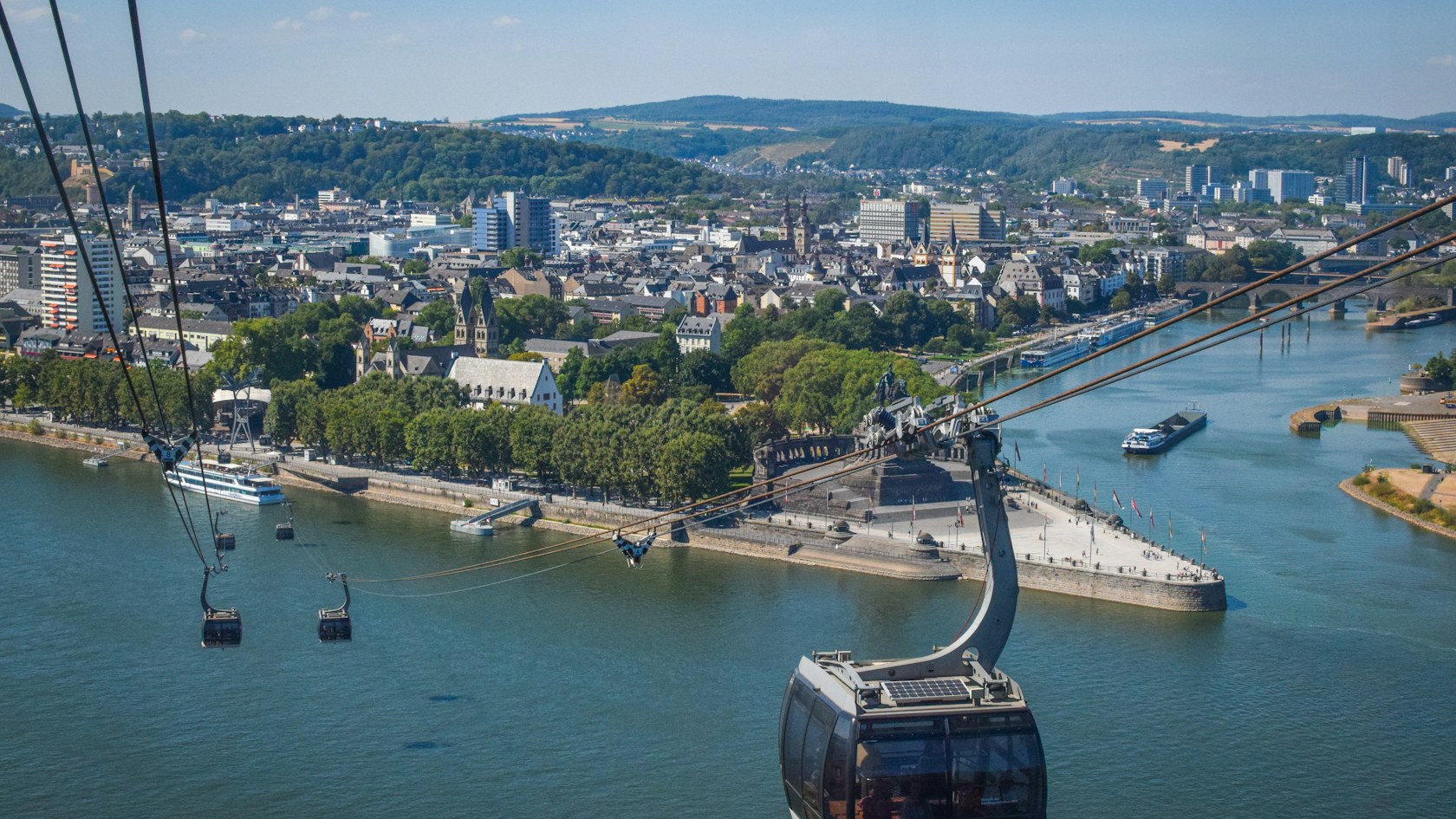
Koblenz is one of Rhineland-Palatinate's five regional centres (Oberzentren), and no other district-free city (kreisfreie Stadt) in the state has so large a surplus of incoming over outgoing commuters: 33,893 in 2024. The city counts 78,359 jobs for its 113,378 residents (end of 2024). For a supermarket, that is daytime demand the population figures do not show — provided the store lies on these commuters' route.
Koblenz pulls in workers and shoppers from across the region
In 2024, 52,428 residents of other municipalities commuted to work in Koblenz and 18,535 commuted out, according to the Rhineland-Palatinate statistical office (Kommunaldatenprofil, June 2025). That is the largest net inflow of any district-free city in the state. The city itself puts its retail catchment at more than 700,000 people. GDP per inhabitant was €81,276 in 2022, against a state average of €41,551.
The population, by contrast, is barely growing. Koblenz had 113,378 residents on 31 December 2024: unchanged on the year and up 1.7% over ten years. The official projection puts the 2040 population only 0.7% above 2020.
Federal agencies, insurance and industry carry the economy
Koblenz is home to the Federal Office of Bundeswehr Equipment, Information Technology and In-Service Support (BAAINBw) and to the headquarters of the Debeka insurance group. Stabilus, Canyon and CompuGroup Medical are based here too. The University of Koblenz has about 9,700 students, and the city also hosts Koblenz University of Applied Sciences. The A 61 and A 48 motorways pass the city, while the B 9, B 42, B 49, B 416 and B 327 federal roads run through it.
Exhibit 1. For 113,378 residents, Koblenz has 78,359 jobs and 52,428 incoming commuters
Sources: Rhineland-Palatinate statistical office (Kommunaldatenprofil, June 2025); NIQ; Rhineland-Palatinate law on the real estate transfer tax rate.
Where commuters pass matters more than what residents earn
For a grocery store, the daily flows of people matter more than residents' purchasing power. Tens of thousands of people come into the city every working day; a supermarket on an arterial road or near a large employer gains customers who never appear in the population statistics. We found no purchasing-power figure for Koblenz itself in open primary sources; for Rhineland-Palatinate as a whole, NIQ gives €30,502 per head for 2026, an index of 97.8.
Objective Z 57 and the city's retail concept set strict limits
Objective Z 57 of the state development programme (Landesentwicklungsprogramm, LEP IV) admits large-scale retail only in central places. Stores of more than 2,000 m² of sales area are allowed only in middle-order centres (Mittelzentren) and regional centres. Koblenz's retail concept (Einzelhandelskonzept) sets three aims: to preserve and strengthen the city centre as a place to shop, to secure local supply in neighbourhood centres and to prevent undesirable development. A store outside these locations needs a solid planning status — verify it against the development plan (Bebauungsplan).
Implications for investors
1. Look for a store on the daily commuter routes. A supermarket on an arterial road, by the station or near large employers gains customers who do not appear in the population statistics.
2. Check the site against Koblenz's retail concept. The concept protects the city centre and local supply in neighbourhood centres; a store outside them needs a solid status under the development plan.
3. Do not base the numbers on population growth. Koblenz grew by only 1.7% in ten years, and the official projection for 2040 is just 0.7% above 2020.
What to check:
• whether the store lies on the daily flows: the roads into the city, the station, large employers;
• the site's classification in Koblenz's retail concept;
• the development plan: special zone, maximum sales area and room to expand under objective Z 57 of LEP IV;
• competitors within a ten-minute drive, including municipalities in the surrounding districts;
• purchasing-power and retail-centrality indices for the catchment: request them from a broker or the local chamber of commerce (IHK);
• the 5.0% real estate transfer tax in the price and yield calculation: €250,000 on a €5 million deal.
See also: Commercial property in Trier; Commercial property in Kaiserslautern; How do you choose a town to buy a supermarket in Germany?; Real estate transfer tax in Germany 2026: rates by state.
Sources: Statistisches Landesamt Rheinland-Pfalz, Kommunaldatenprofil "Kreisfreie Stadt Koblenz" (23 June 2025); Stadt Koblenz, "Einzelhandel" page (October 2026); Landesentwicklungsprogramm Rheinland-Pfalz (LEP IV), objective Z 57; NIQ, Kaufkraft Deutschland 2026; Debeka, legal notice (Impressum); Universität Koblenz; Wikipedia, "Koblenz" article (regional-centre status, transport, institutions and companies; October 2026); Rhineland-Palatinate law on the real estate transfer tax rate. Legal position as of October 2026.
Photo: Rob Hall / Unsplash
This page is general information and not investment, legal or tax advice.